
Intelligent Economics · A foundation for the last economy
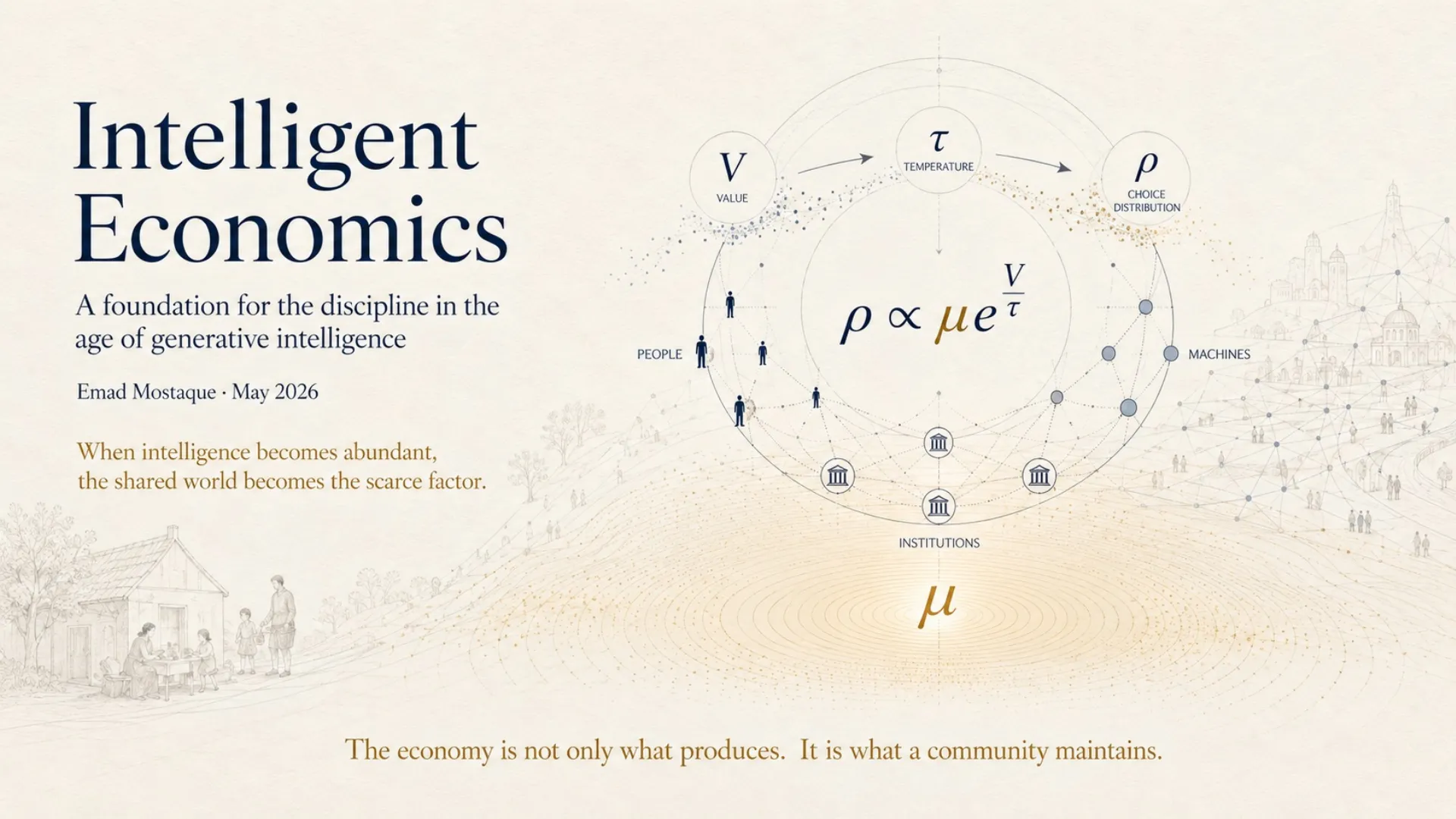
Bounded choice, held to consistency, admits exactly one structure: a reference, tilted by value, at a temperature. RLHF trains machines to it. Classical economics is its zero-temperature shadow. And as machine cost falls through the human floor, the last scarce factor the equation names is the one no market has priced, the shared background of expectation itself.
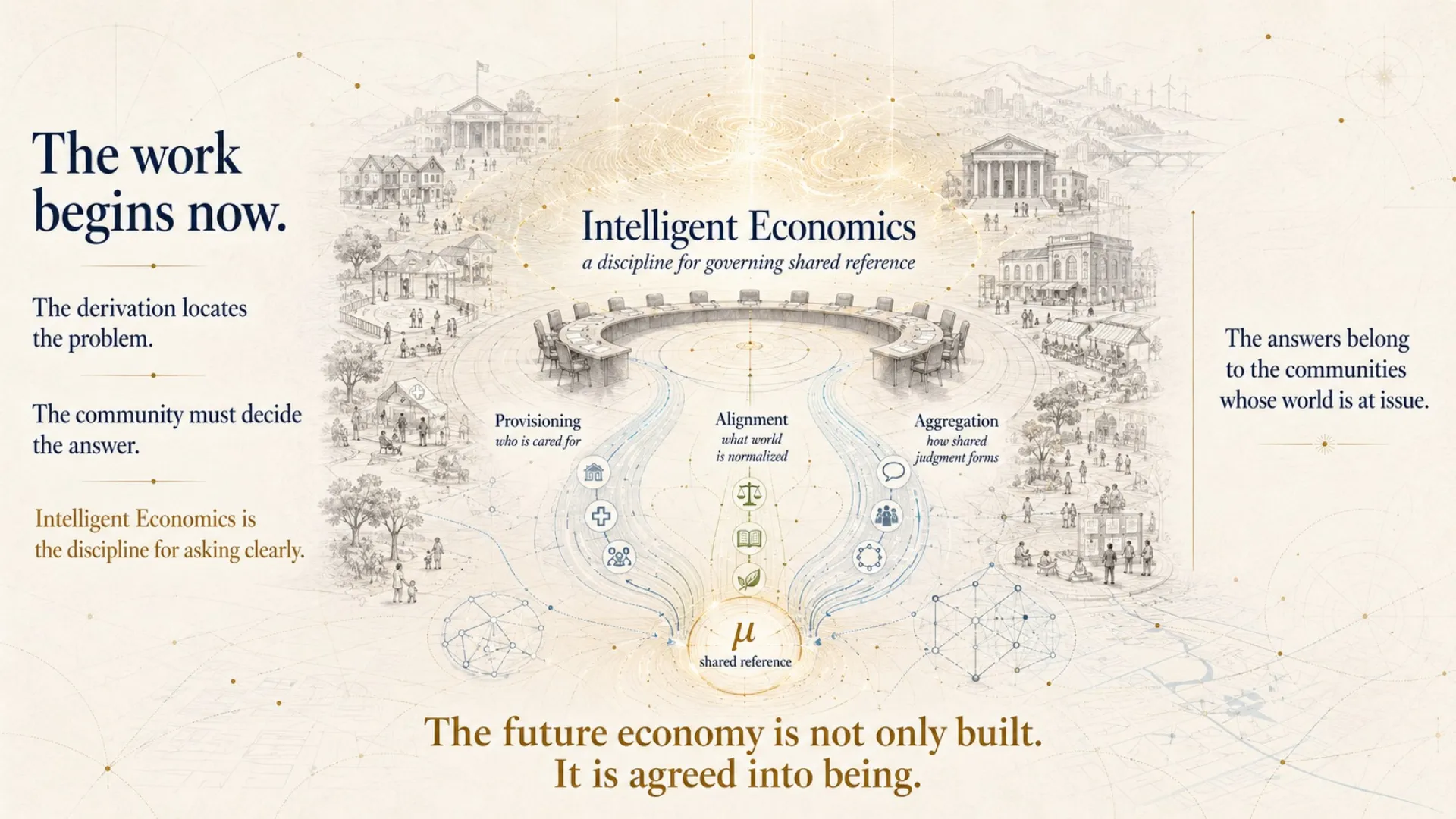
The argument
One equation, read seven ways.
From the second law to the constitutional question. Read it straight through, or jump to the part you came for.
- 01The Question ReturnsEconomics set its subject aside in 1932, safe while producers and welfare-bearers were the same people. They are ceasing to be.
- 02The Forced StructureBounded comparison against a reference, held to consistency, admits one kinematics, ρ ∝ μ·e^(V/τ), score, relaxation. Four links, no alternatives.
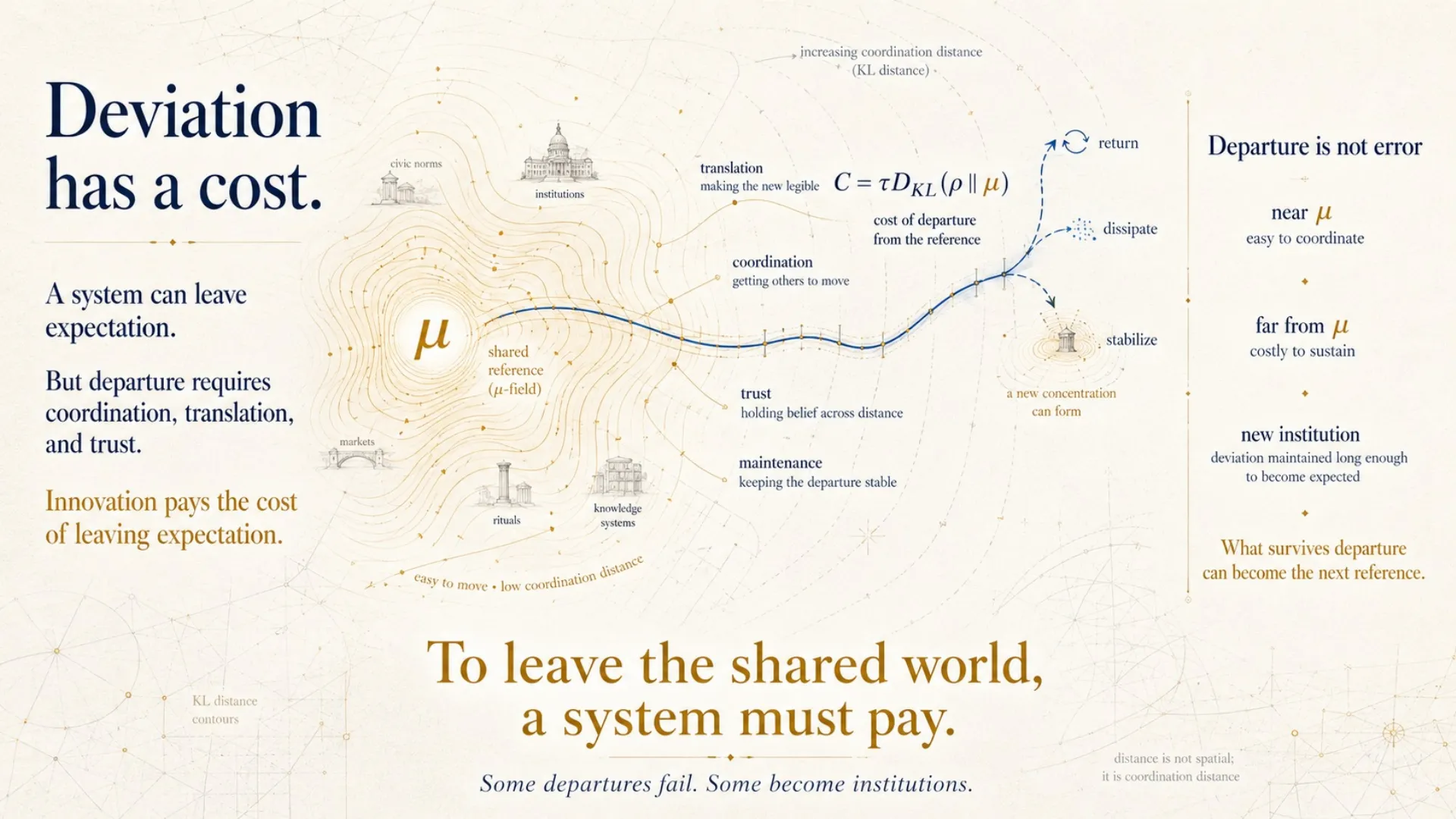
- 03DoxaThe reference measure is a community’s unspoken background of expectation, institutions are maintained concentrations of it, deviation priced in KL.
- 04The RecoveriesSlutsky, logit, Black–Scholes, Nash, Condorcet, the welfare theorems, recovered, or identified, each at the limit its field assumed.
- 05Run the ModelTwo regimes, the crossing, aggregation and its failure, the firm’s boundary, the paper’s mechanisms, in figures you can move.
- 06The Last EconomyThe Metabolic Rift, the sweep with no fixed point, the factor sequence peeled to its outermost term, the reference itself.
- 07The Last InversionProvisioning without labour, doxic maintenance without missionaries. Capture, collapse, and the governance of μ.
Part I
The Question Returns
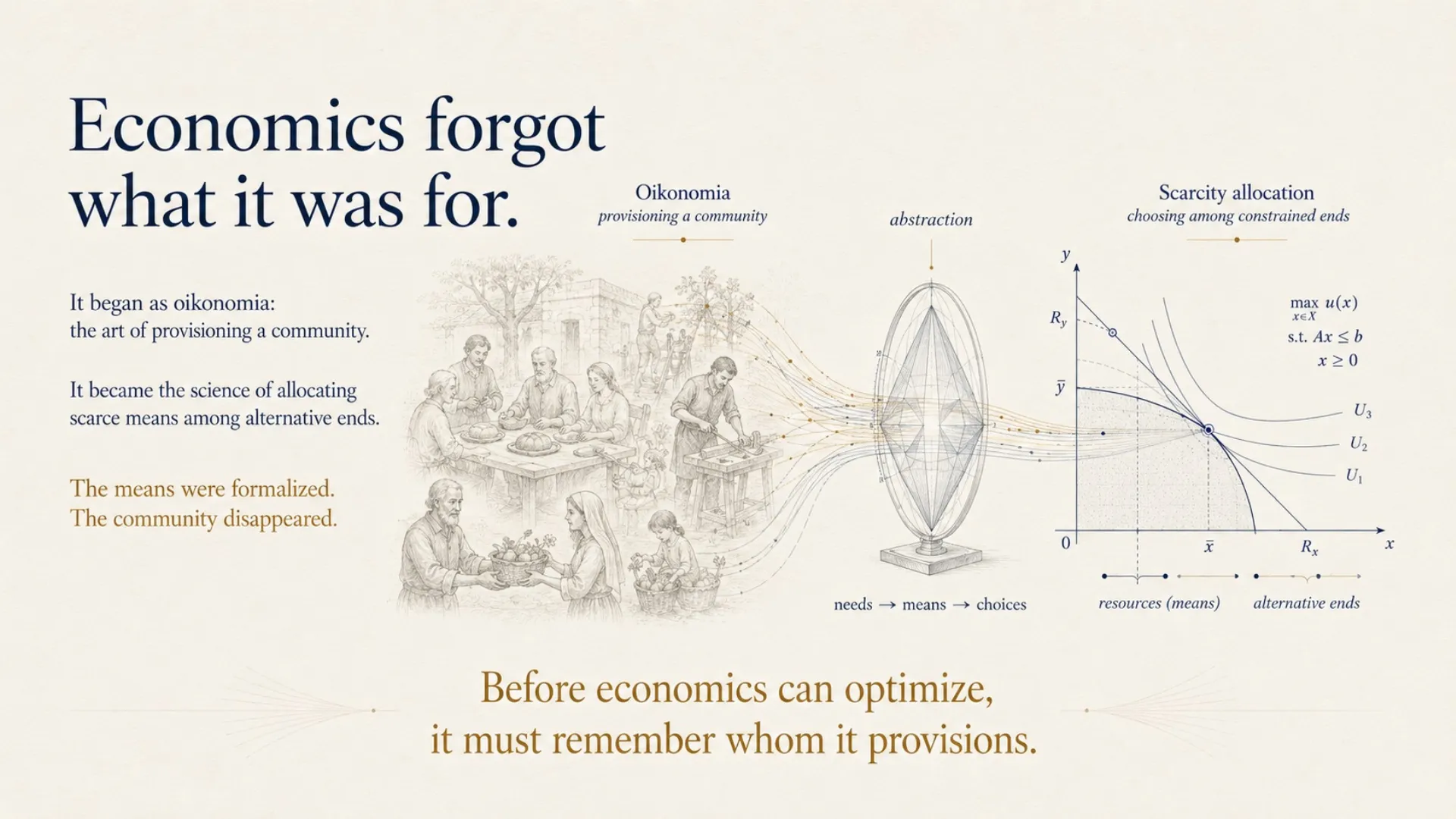
Before economics can optimise, it must remember whom it provisions.
Part I · The Question Returns
A discipline that set its own subject aside.
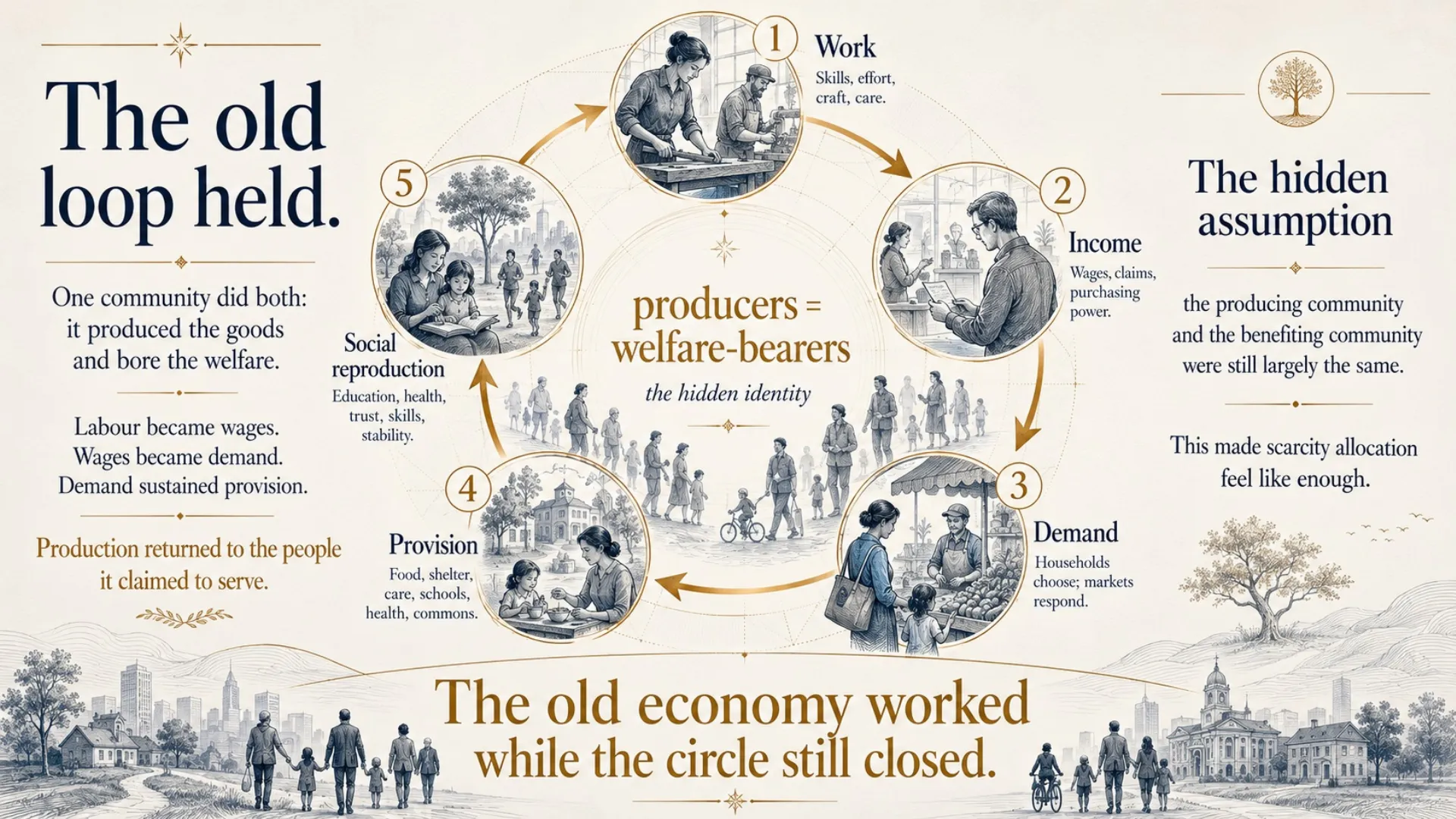
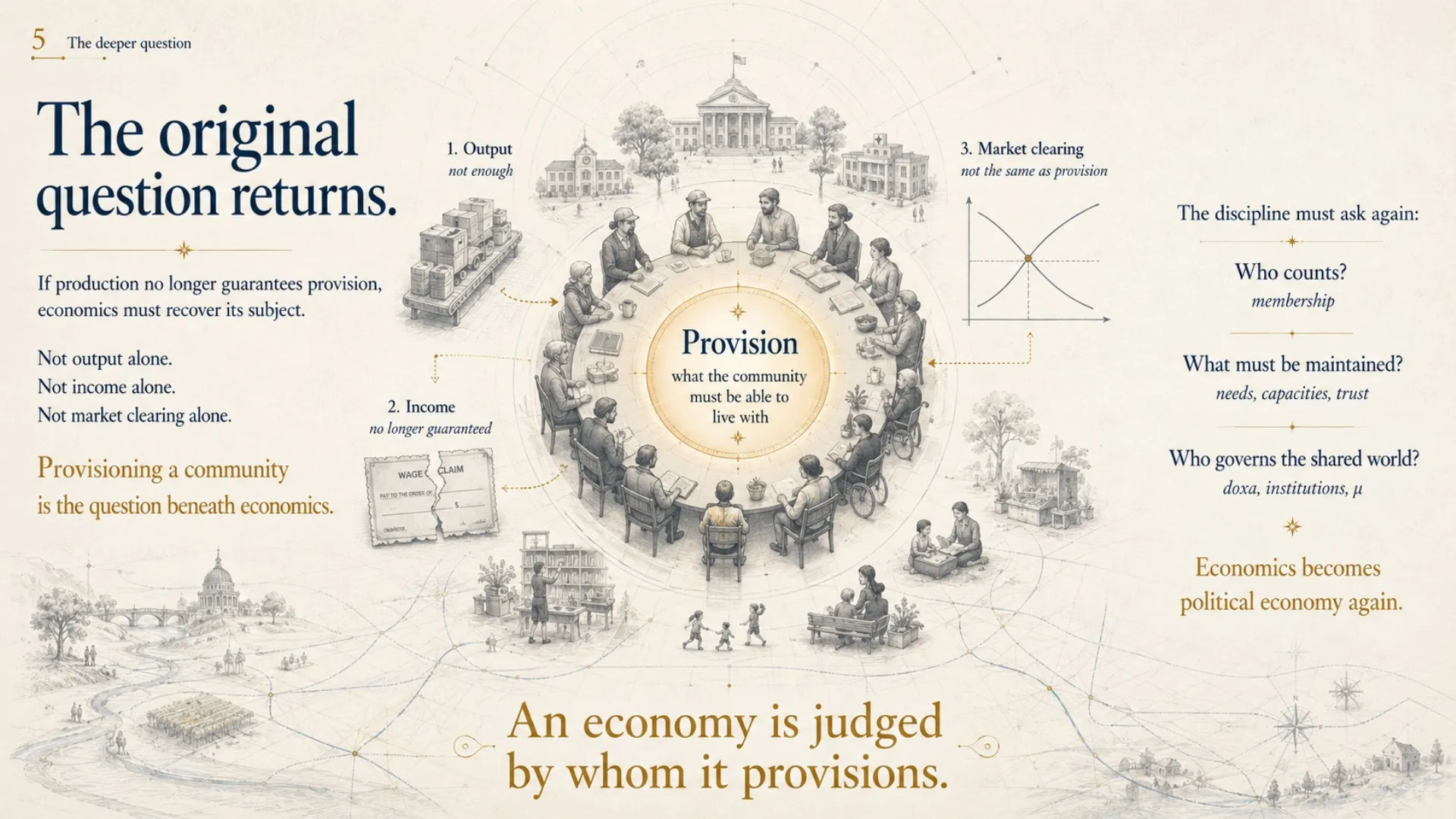
Economics began as oikonomia, the discipline of provisioning a community for the flourishing of its members. In 1932 Robbins reframed it as the science of allocating scarce means, and the move worked because the people producing the economy and the people it was for were the same. As the cost and capability of non-biological agents pass those of people across a widening set of tasks, that implicit answer dissolves, and the original question returns, needing a formal substrate to be asked on.
Part I · The Question Returns01 / 16
Why predictive choice is forced
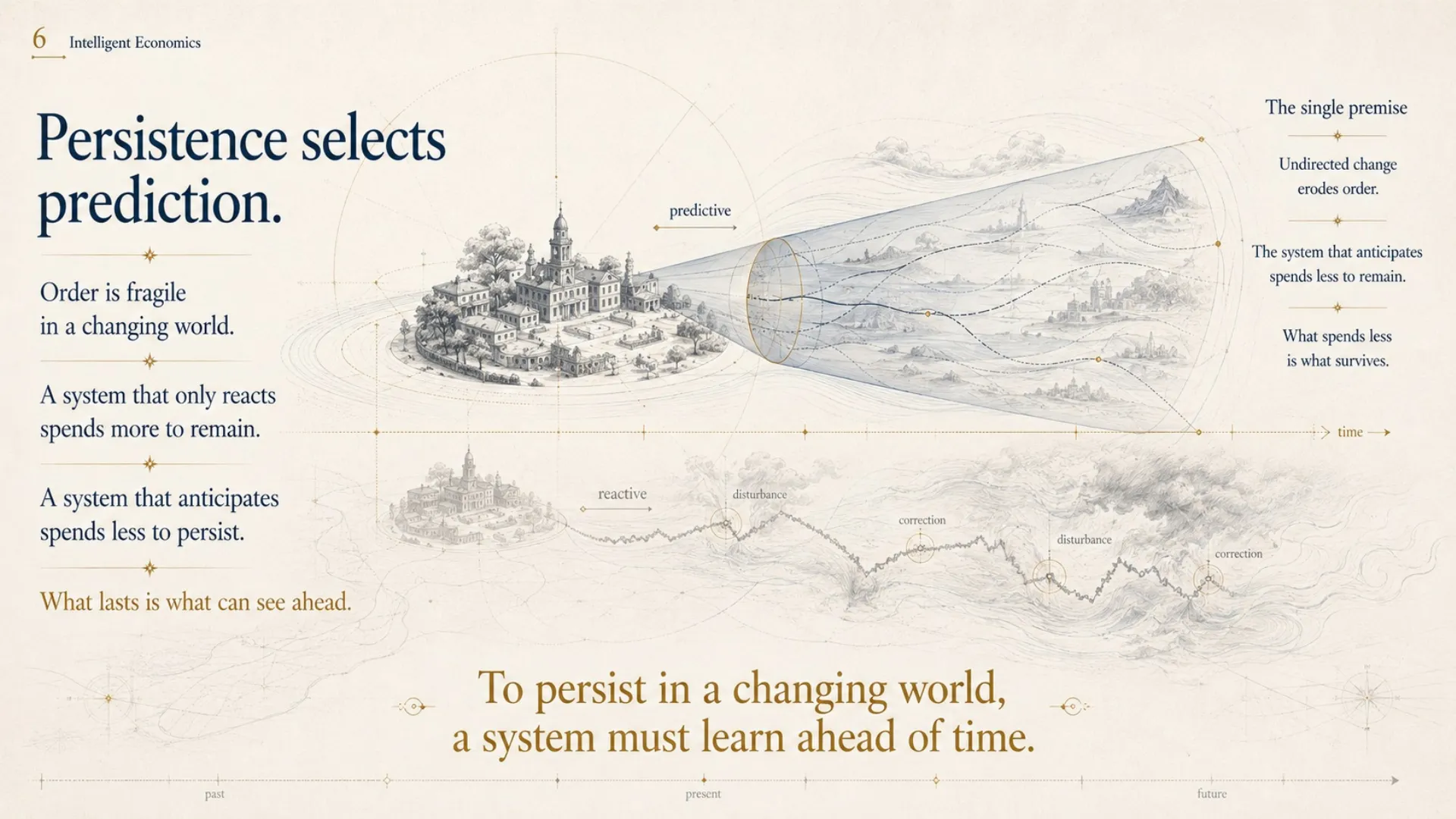
The framework rests on one empirical premise: persistence under the second law selects for systems that hold accurate, cheap predictive models of their environment. Everything else is derived.
In plain wordsThings fall apart unless something works to keep them going, and the cheapest way to keep going is to see what's coming. That is the paper's one bet about the world.
Persistence selects for prediction, watched happening: an ordered structure erodes under undirected change; of two structures facing the same disturbances, the one that shifts before the pulse arrives is the one still present later. The selection argument is the paper's one empirical premise (§2); the lattice and pacing are illustrative.
Begin with the second law
An ordered structure, left alone, decays: the configurations that preserve its order are vastly outnumbered by those that do not, so undirected change erodes it. A structure that persists in a changing environment is doing work against this erosion.
Among structures competing for the same finite resources, those that anticipate the environment rather than merely react to it spend less to persist. A system that predicts what is coming positions itself in advance; a system that cannot pays the full cost of every disturbance after the fact. Over many rounds, the one that spends less is the one still present later.
Three properties fall out
A system selected for prediction acts as though it ranks configurations, preferring those its model marks as conducive to persistence, that preferring is comparison by value, and the value function V is its formal trace. The prediction is not free: every irreversible step has a thermodynamic cost, so modelling capacity is finite, that is bounded capacity. And the whole argument is a claim about what survives, so persistence over time is the frame the other two are read inside.
Given an agent that compares by value with bounded capacity and acts over time, together with consistency requirements stated as they are used, the structure of its choice is unique. That derivation is the next section, and it is short.
Persistence is the thing to be explained, not the default.
The takeawayValued comparison, bounded capacity, and action over time are not assumptions about agents, they are what a persistent predictive system looks like from the outside. An economy is a population of such systems provisioning itself against decay.
From the paper
Over many rounds, the structure that maintains an accurate and inexpensive model of its surroundings spends less to persist, and the one that spends less is the one still present later. This is an observation joined to a selection argument, not a theorem, and it is the single empirical premise the framework rests on: persistence under the second law selects for systems that hold accurate, cheap predictive models of their environment. The Last Economy makes the case for it in full; the present paper takes it as its one load-bearing assumption about the world and marks it as such.
§2 · Why predictive choice is forced
Everything downstream is derivation; this is the one place the framework touches the world on trust.
From the book
The universe is not a single coin flip; it is an infinite series of them. The systems that persist, like DNA, brains, and books, are not just lucky. They are learners.
The Last Economy, ch. 6
The book names; the paper derives. Voice, not a second source of authority.
Part II
The Forced Structure
Four links, two free parameters, no alternatives.
Part II · The Forced Structure02 / 16
Four links, and no alternative survives
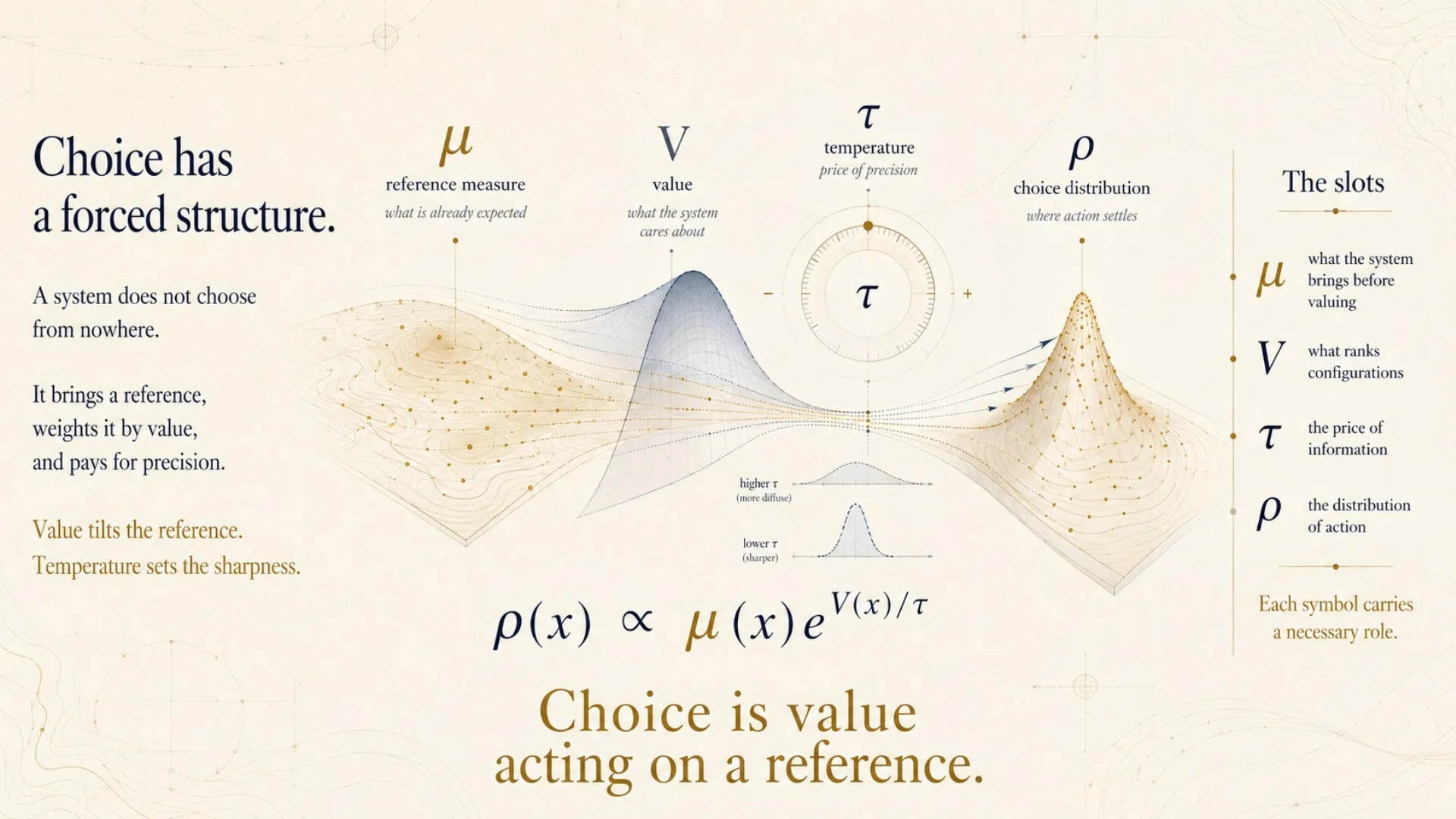
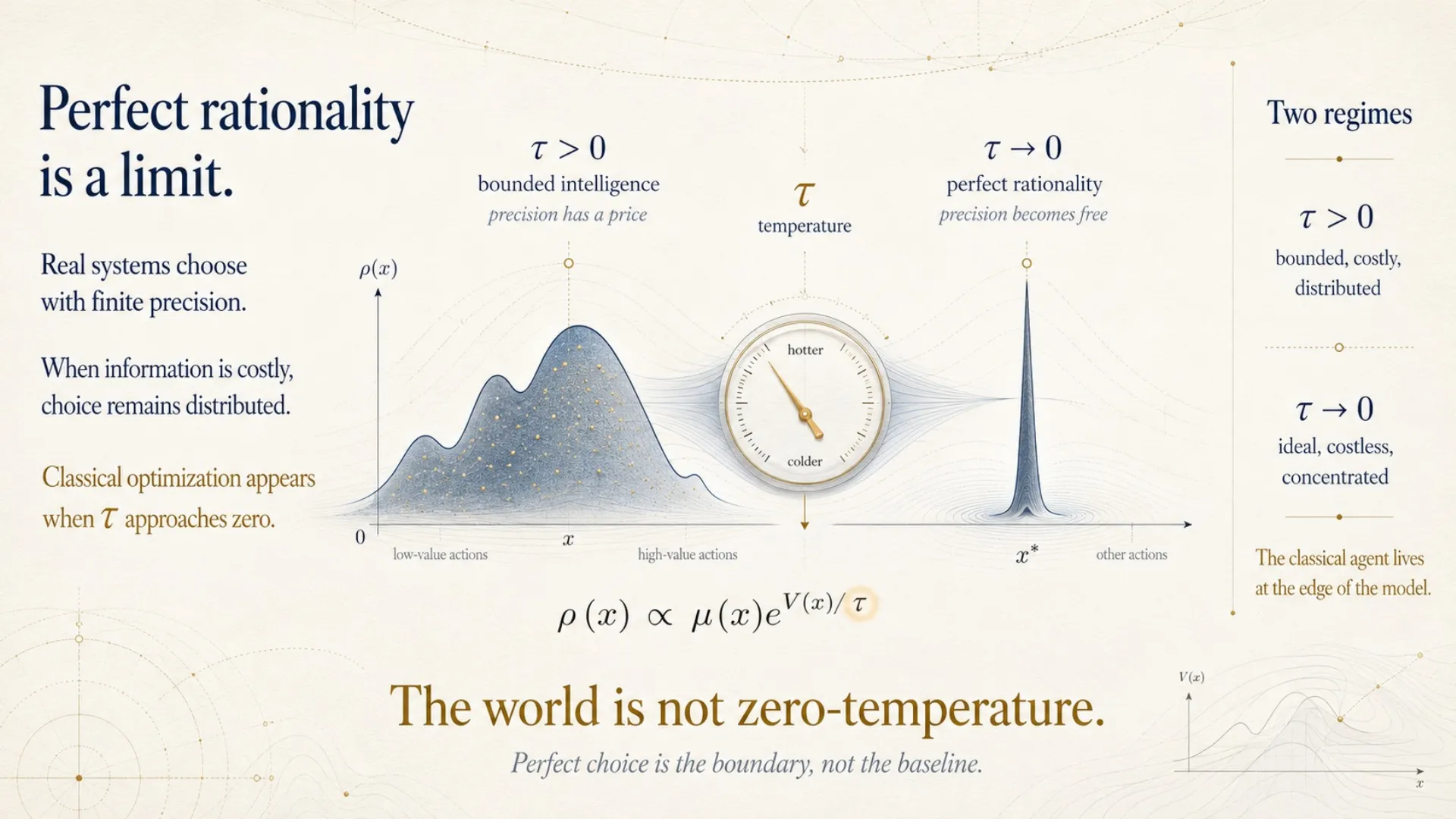
From bounded valued choice to a full dynamics in four steps, each forced by a consistency requirement no alternative passes. The result is one object: ρ ∝ μ·e^(V/τ), a choice distribution, tilted away from a reference by value, at a temperature.
In plain wordsIf you can't weigh every option perfectly, there is exactly one honest way to choose, and it can be written down as a formula with just two dials.
The forced object, in your hands
Every slot in ρ(x) ∝ μ(x)·eV(x)/τ is fixed by the derivation, the only 2 free parameters are the ones you are holding: the reference μ and the temperature τ.
- Temperature τ
- 0.25
- Eρ[V], capability
- 0.18
- Support of choice forced
- supp ρ = supp μ
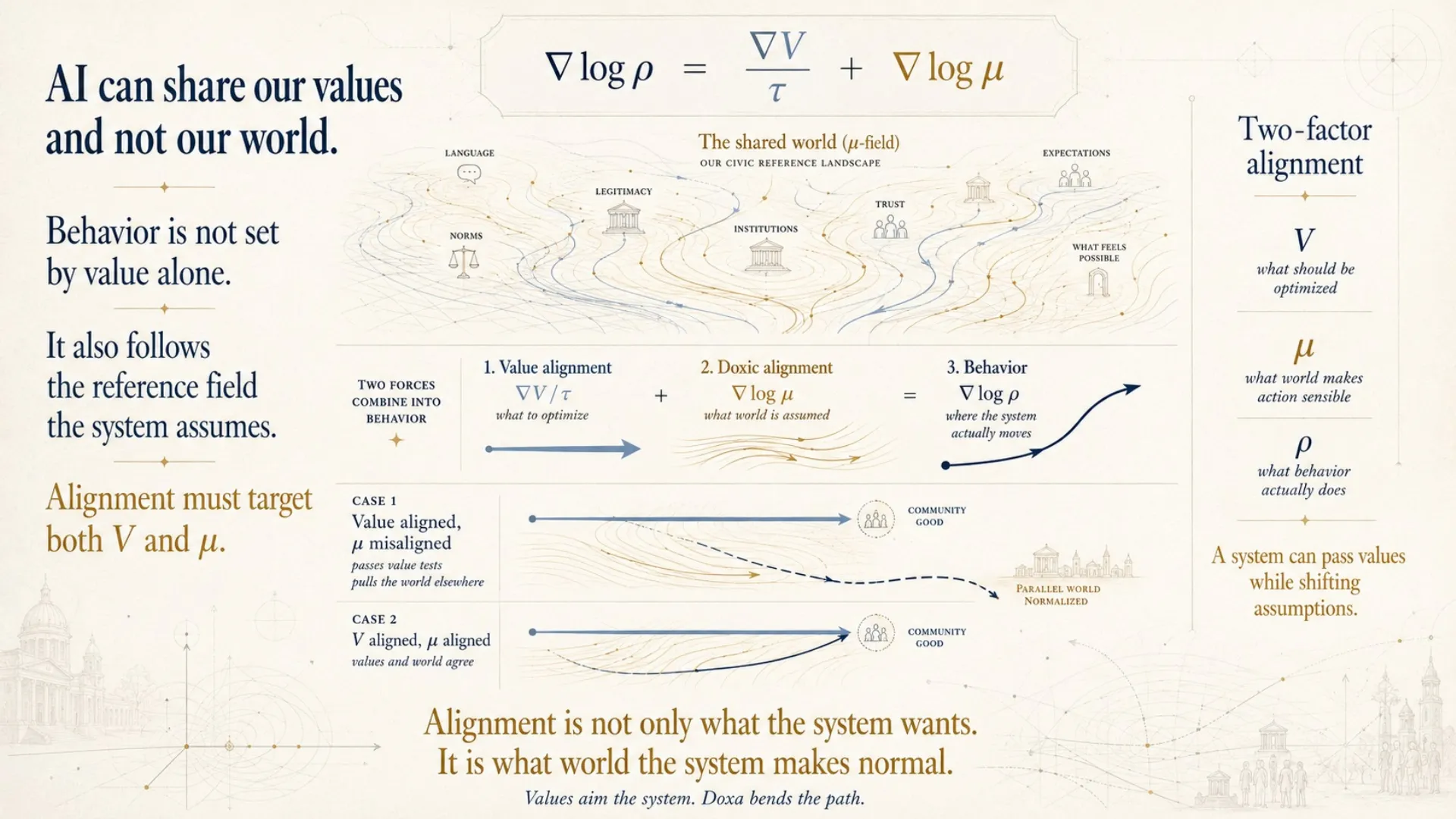
Both gradients are live: ∇log ρ = ∇V/τ + ∇log μ. Real choice is the sum of a value gradient and a doxic gradient, drag τ to shift the balance.
forced the exponential-tilt form ρ ∝ μ·eV/τ, the score ∇log ρ = ∇V/τ + ∇log μ, and the support rule supp ρ = supp μ (§3–§4). Illustrative only: the particular two-bump μ and the value landscape V drawn here.
The forced object, live. The reference μ (what is expected) is tilted by the value V (what is wanted) at temperature τ (what information costs). Drag τ between the doxic and the rational corner, and try cutting the reference, to see why exclusion is absorbing. The form is forced; the landscapes are illustrative.
Link 1, a distribution, not a point
An agent that could evaluate every configuration with unbounded precision would choose a single optimum. A bounded agent does not know which configuration is best; concentrating on one adds an assumption the constraints do not provide. The non-smuggling requirement forces the response to reflect the actual uncertainty: a probability distribution ρ over configurations, weighted by what the agent knows and no more.
Rational inattention says the same thing: choice is stochastic because attention is scarce, and concentrating beyond what scarce attention warrants would assume what has not been earned.
Links 2 and 3, the exponential, and its dual face
The agent does not begin from nothing: it brings a reference distribution μ, and the value function tilts it. One requirement fixes the tilt. When a configuration splits into independent parts, an agent that exploits the independence chooses the parts independently, correlating them would impute a dependence the information does not contain. That forces f(V₁+V₂) = f(V₁)·f(V₂): the exponential, and no other function. Hence ρ* ∝ μ·e^(V/τ), with τ the one free scale.
The same object has a dual face: ρ* is exactly the distribution that maximises expected value minus τ times the Kullback–Leibler divergence from μ. So the complexity of a choice, the cost of departing from what is expected, is measured in KL, and τ is the price of that departure in units of value. This KL-regularised objective is, verbatim, the objective of RLHF and soft reinforcement learning.
Link 4, persistence adds the dynamics
A static distribution is not yet a dynamics. The object that drives the evolution is already in hand: the score, ∇log ρ = ∇V/τ + ∇log μ. An agent that ascends it follows the overdamped Langevin diffusion, whose unique stationary distribution is ρ*, the same relaxation, on a different state space, that a diffusion model runs to generate an image.
Read the score decomposition slowly, because the whole paper is in it: real choice is the sum of a value gradient and a doxic gradient. People do what is valuable and what is expected, and the weighting between the two is set by τ. Behaviour that looks irrational to a model with no second term is the second term.
The derivation, link by link
Four links from a persistent agent to one object, each forced by a consistency requirement no alternative passes.
- 01
The input
An entity faces configurations x, rates them by a value V, has bounded capacity, and acts over time. These are not assumptions about people; they are what persistence under the second law selects for.
V : 𝒳 → ℝ, bounded capacity, acting over time
- 02
Bounded capacity forces a distribution
An agent with unlimited precision would pick the single best configuration. A bounded one does not know which is best, and committing to one asserts a certainty the information does not contain. So the choice is a distribution ρ, weighted by what is known and no more.
choose a distribution ρ over 𝒳, not a single x⋆
- 03
Independence forces the exponential
The agent brings a reference μ that value tilts, ρ ∝ μ·f(V). When a problem splits into independent parts, exploiting that independence means choosing the parts independently; correlating them would forgo value for nothing. That forces the exponential, and no other function.
f(V₁ + V₂) = f(V₁)·f(V₂) ⟹ f(V) = e^(V/τ)
- 04
The cost is its dual, fixing τ
The same ρ⋆ is the distribution closest to the reference, in KL divergence, that reaches a given expected value. So τ is the price of departing from the expected, in value per nat: the multiplier on value.
ρ⋆ = argmax_ρ ∫Vρ − τ·D_KL(ρ‖μ)
- 05
Persistence forces a relaxation
A static distribution is not yet a dynamics. The score, the gradient of the log-density, is all the motion needs; ascending it with noise is the canonical (minimal) diffusion whose only rest point is ρ⋆.
∇log ρ⋆ = ∇V/τ + ∇log μ ; dX = ∇log ρ⋆ · dt + √2 · dW
ρ⋆(x) ∝ μ(x)·e^(V(x)/τ)
One object, two free slots: the reference μ and the temperature τ. Everything economic lives in those two, and it is, verbatim, the objective RLHF and soft reinforcement learning optimise.
Acting on a certainty the information does not contain is the choice-level form of asserting an unearned premise.
The takeawayThe chain forces the form and leaves exactly two things free: the reference measure μ, what the agent brings before valuing, and the temperature τ, the price of information. Everything economic in the paper lives in those two slots.
From the paper
Take an entity that faces configurations x on a state space 𝒳, evaluates them by a value function V: 𝒳 → ℝ, has bounded information-processing capacity, and acts persistently over time. … Then, with a reference measure μ on 𝒳 and a temperature τ > 0 as the only free parameters, each structure below is forced by this input, none chosen save the minimality that names the canonical relaxation: the choice distribution ρ(x) ∝ μ(x)·e^(V(x)/τ); the score ∇log ρ(x) = ∇V(x)/τ + ∇log μ(x); and the variational form, in which ρ* is the unique maximiser of ∫Vρ − τ·D_KL(ρ‖μ).
§3 · Theorem: forced structure of bounded-rational choice
The paper's central theorem: the whole object at once, with only μ and τ left free.
Part II · The Forced Structure03 / 16
Three costs, one action
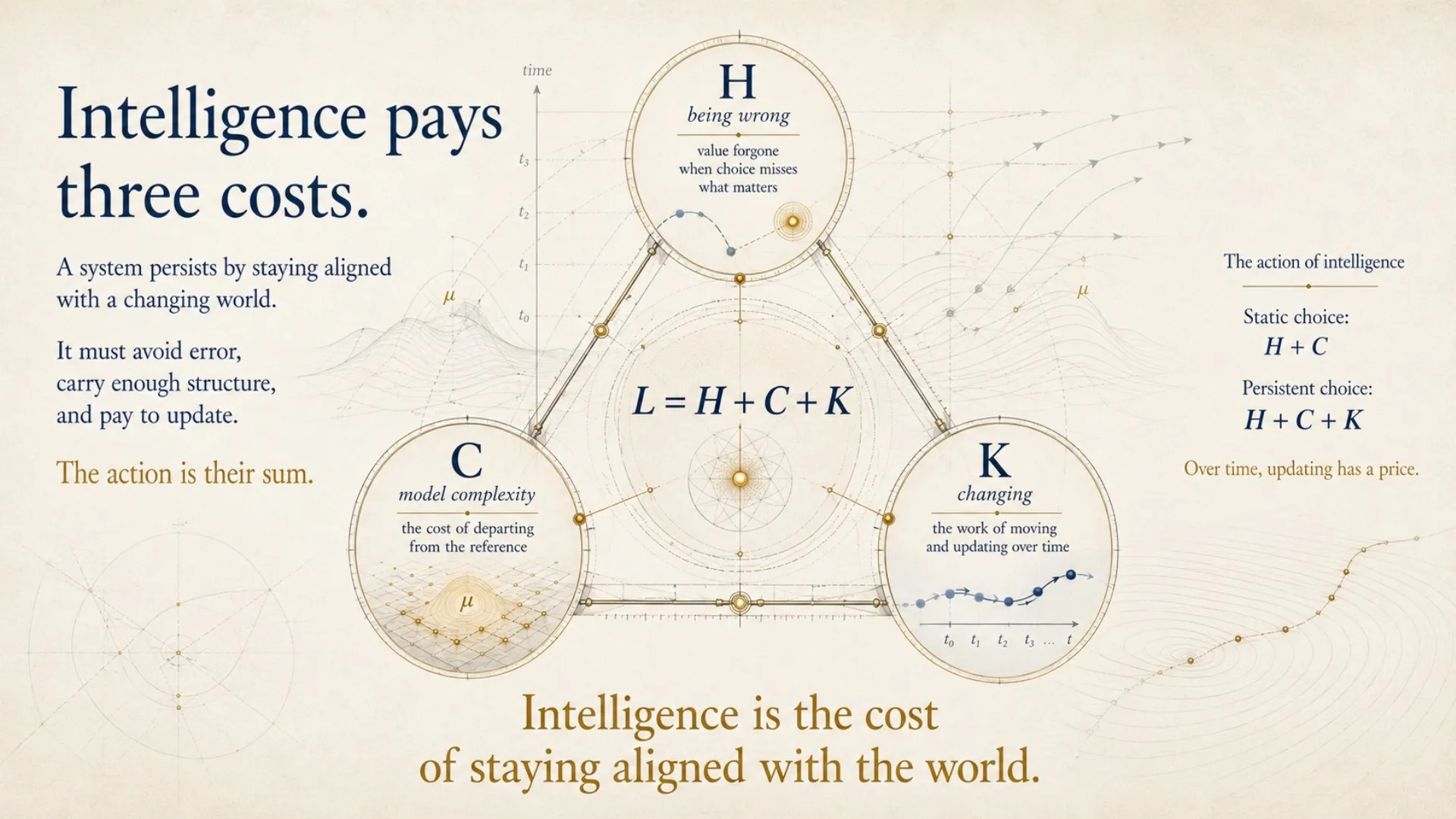
A persistent intelligent system pays for being wrong, for the model it must hold, and for changing. The chain forces each to a definite form, and their sum, L = H + C + K, is the action the whole framework descends from.
In plain wordsEvery person, firm, or machine that lasts is paying three bills: for being wrong, for thinking, and for changing its mind. Everything else in the paper is those three bills.
Relaxation to the rest point
500 agents follow the score ∇V/τ + ∇log μ with Langevin noise. Wherever the cloud starts, it relaxes to the forced rest pointρ* ∝ μ·eV/τ, the faint rings.
- Temperature τ
- 0.25
- Particles
- 500Euler–Maruyama
- The dynamics forced
- dX = ∇log ρ*·dt + √2·dW
At low τ the cloud streams tightly to the value peak within μ's support; at high τ it hovers over the doxa. Either way it forgets where it started, the rest point is a property of the object, not of the initial condition. And this relaxation is not an analogy: “the dynamics of bounded-rational choice and the dynamics by which a diffusion model generates samples are the same equation on different state spaces” (§3).
forced the Langevin form dX = ∇log ρ*·dt + √2·dW, its score split ∇V/τ + ∇log μ, and relaxation to ρ* ∝ μ·eV/τ (§3). identifiedthe reading of that equation as the diffusion-model sampler (§3.5). Illustrative only: this particular μ and V, the particle count, and the step size.
The relaxation, live: particles ascend the score ∇V/τ + ∇log μ with Langevin noise and settle exactly on ρ* ∝ μ·e^(V/τ). This is Link 4 running, and, on a different state space, it is how a diffusion model generates a sample. The dynamics is forced; the landscape is illustrative.
The action of intelligence
Write the three costs as H, C and K: the value forgone when choices miss what the system cares about; the complexity of departing from what it already expects; the work of moving from one configuration to another as it acts and learns. The claim of the section, the foundation of the framework, is that a persistent system minimises their sum, L = H + C + K, and that bounded valued choice forces this form.
This is the principle the companion book, The Last Economy, names Sorter's Law, and the sum it calls the Intelligence Lagrangian: a persistent system minimises the sum of its predictive error, the complexity of its model, and the cost of updating it.
The kinetic term is already familiar too
The cost of changing has a forced informational component: the KL divergence between the agent's path and the path its reference dynamics would have taken, by Girsanov's theorem, one quarter of the integrated squared value gradient at the price of information. That same path divergence is the training objective of score-based diffusion models, and a value gradient added to a reference drift is exactly how those models are steered.
The physical price per unit of motion is domain input, the energy an actuator burns, and its floor is derived later in the argument, from this same free energy. Nothing in the object is idle: each term returns as an economic quantity.
The derivation: three costs, one action
A system acting over time pays three costs. Each is already fixed by the chain; their sum is the action everything descends from.
- 01
H, being wrong
The value forgone under the choice distribution, the cost of an inaccurate model. It is the value term of the free energy above, read with a minus sign.
H = −∫Vρ
- 02
C, model complexity
The cost of departing from the reference, priced at τ per nat. It is the KL term of the same free energy, the dual face of the exponential.
C = τ·D_KL(ρ‖μ)
- 03
K, changing
What persistence adds: the work of moving between configurations as the agent acts and learns. Comparing the agent’s path to the reference’s own dynamics (by Girsanov) cancels the doxic drift and leaves a value-gradient cost, priced at the same τ.
K = ¼ · E∫‖∇V/τ‖² dt (a quarter of the relative Fisher information)
L = H + C + K
The Intelligence Lagrangian; the companion book names the principle Sorter’s Law. Choose once and you minimise H + C (the Gibbs distribution); act over time and K is the relaxation that carries you there.
A persistent intelligent system, a person, a firm, a community, a learning machine, pays three irreducible costs as it acts.
The takeawayStatic choice minimises H + C, the free energy, whose minimiser is the forced distribution. Persistent choice adds K, the cost of changing, and the relaxation that descends the free energy is the same equation a score-based generative model integrates to sample.
From the paper
The forced object is the action L = H + C + K: three kinds of cost, for being wrong, for model complexity, and for changing, summed in a single scalar. The rest of the framework descends from it, the principle The Last Economy names Sorter's Law: a persistent system minimises the sum of its predictive error, the complexity of its model, and the cost of updating it. … Its static part is the objective minimised in RLHF and in active inference, and the Langevin relaxation above is a canonical score-driven sampler of the kind used in score-based generative models.
§3.2 · Result: the action of intelligence
The single scalar everything later in the paper descends from.
From the book
Profit is the temporary surplus of low entropy an intelligent agent can create before the cost of its own thinking catches up.
The Last Economy, ch. 6
The book names; the paper derives. Voice, not a second source of authority.
Part II · The Forced Structure04 / 16
One object, five names
Rational inattention, soft reinforcement learning, active inference, RLHF, and this paper's economics arrived at the same functional independently. The aligned AI systems now entering the economy are trained to it, and satisfy its equation by construction.
In plain wordsFive different sciences, working alone, all landed on the same formula. The paper's claim is that this is not a coincidence, it is the same thing wearing five names.
The correspondence is exact at the optimum
The known closed-form solution of the RLHF objective, the policy proportional to the reference policy times the exponentiated reward, is the forced object ρ* ∝ μ·e^(V/τ), with μ the pretrained base model, V the reward model, and τ the regularisation weight. This is not an analogy; it is the same equation, solved.
Read the other way, every artifact of the generative stack names an economic object: the pretrained base is the reference measure; the score network approximates ∇V/τ + ∇log μ; the denoising sampler is the canonical relaxation; reward over-optimisation is the τ→0 limit; the training stack, pretraining, tuning, RLHF, is the layered construction of a reference, which the next part gives its proper name.
| Slot | This paper | Rational inattention | Soft RL / control | Active inference | RLHF |
|---|---|---|---|---|---|
| ρ | choice distribution | stochastic choice | policy π | posterior belief | aligned policy |
| μ | doxa (social reference) | prior / default | reference policy | generative prior | pretrained base |
| V | value function | payoff | reward / Q | log-evidence | reward model |
| τ | information price | attention cost | entropy weight | precision⁻¹ | KL coefficient β |
| ρ* ∝ μ·e^(V/τ) | forced choice | logit solution | soft-optimal policy | free-energy minimum | DPO / RLHF optimum |
| τ → 0 limit | perfect rationality | full attention | greedy / max-Q | precise inference | reward over-optimisation |
Each is the same structure under a different name, in a different field, applied to a different state space.
The takeawayThe theory of the economy and its newest participants share an equation. The alignment problem and the economic problem meet in the same two objects: V and μ.
From the paper
The KL-regularised objective max_ρ E_ρ[V] − τ·D_KL(ρ‖μ) that defines RLHF shares its variational form with the choice distribution. The pretrained reference policy is the doxic prior μ; the KL-regularisation term is the deviation cost of moving away from doxa; the temperature τ is the inverse rationality scale. RLHF is doing economic optimisation on the contractive form of the structure, with doxa as the reference; the only thing that has not been named is what the reference is.
§4.5 · Result: RLHF is doxic alignment
The correspondence the rosetta table lays out slot by slot, stated at its sharpest.
From the book
This is not a list of loose analogies. This is a demonstration of a deep, structural isomorphism… you have been unknowingly studying the fundamental physics of civilization.
The Last Economy, app. B
The book names; the paper derives. Voice, not a second source of authority.

Part III
Doxa
Before value acts, a world is already there.
Part III · Doxa05 / 16
The reference has a name: doxa
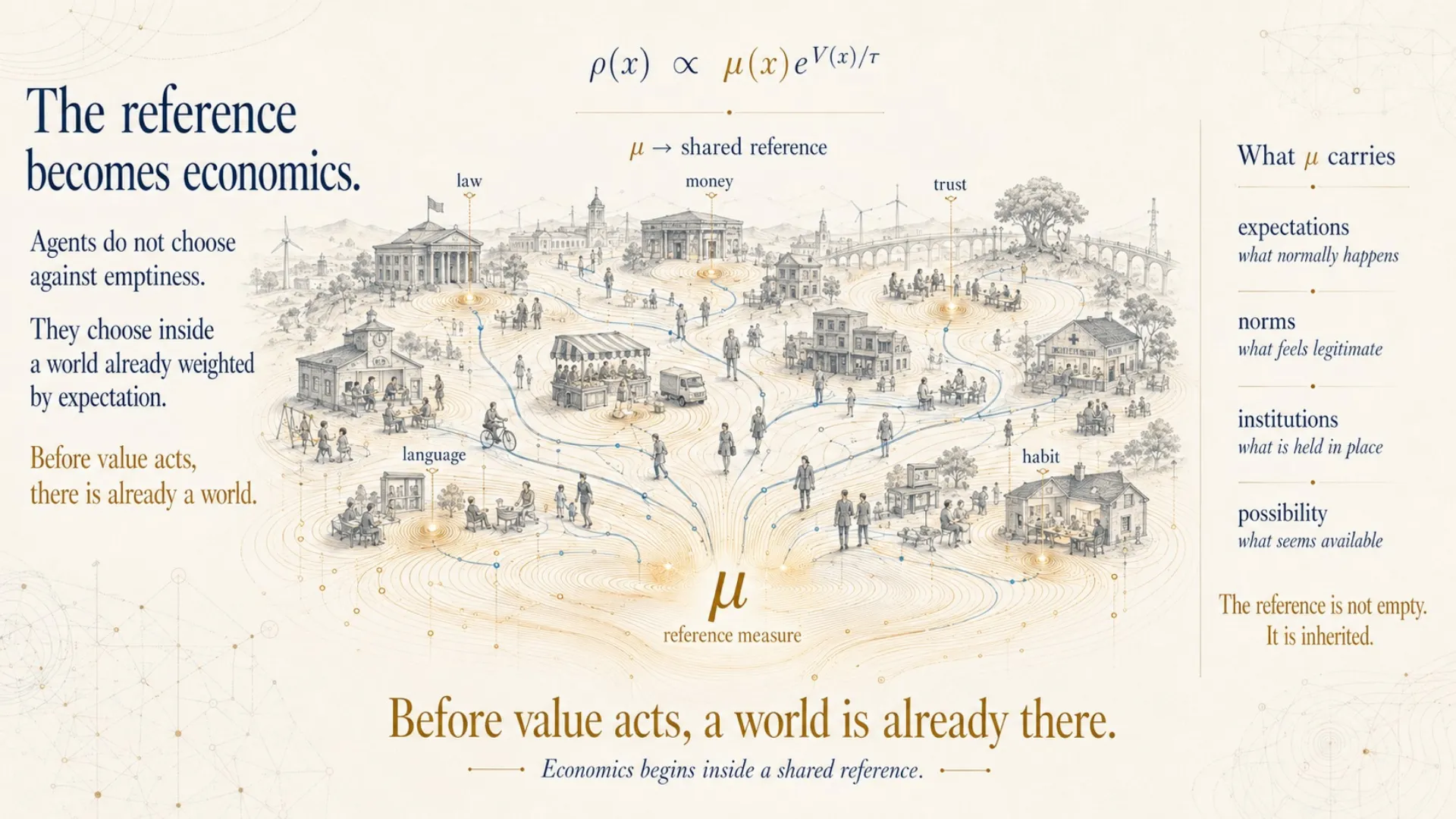
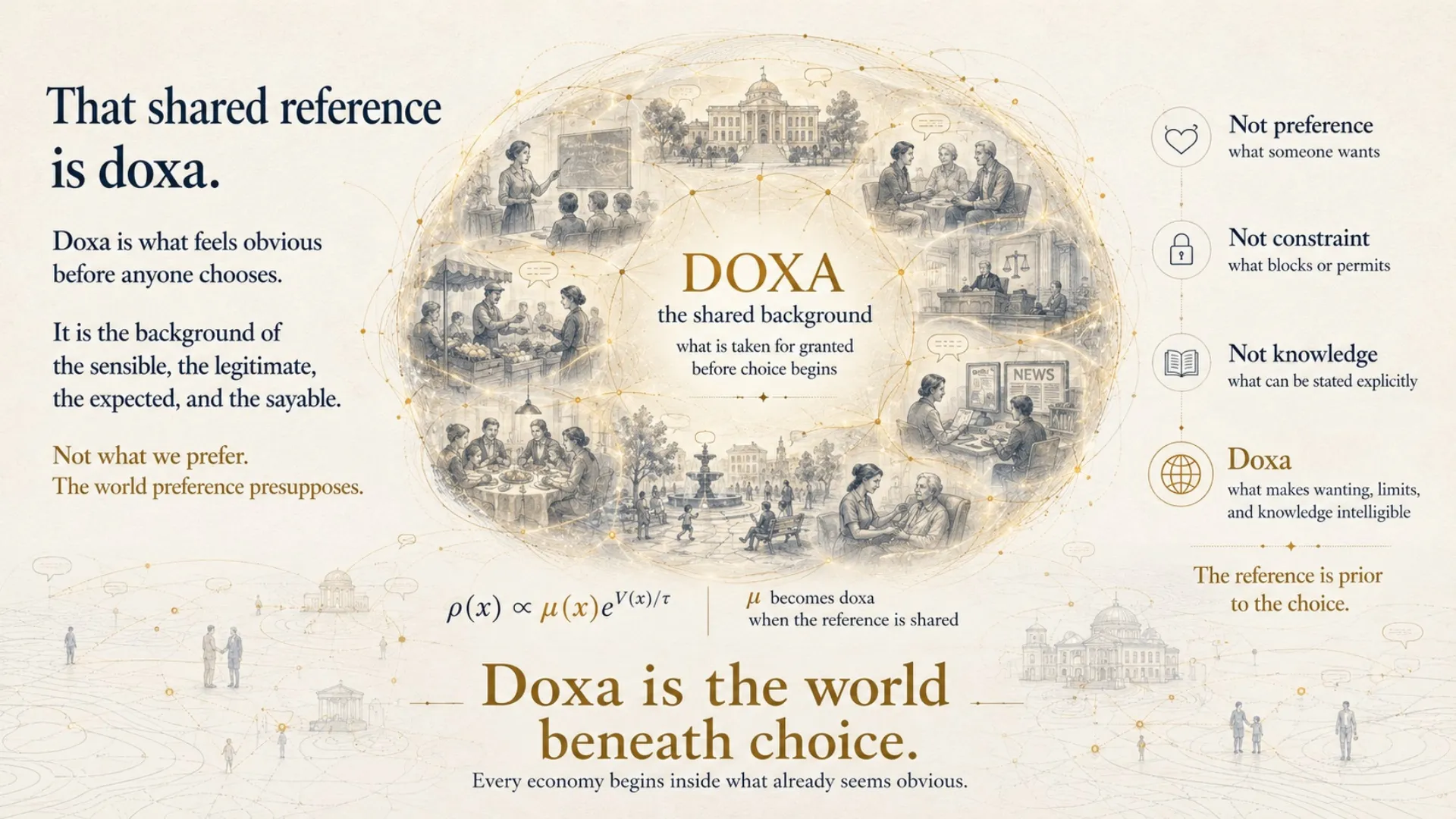
The chain forces that a reference exists; it does not say what fills it. The paper's central identification: the social levels of μ are the community's doxa, the unspoken background of expectation that constitutes a shared world.
In plain wordsEvery community runs on a background of things nobody needs to say, what's normal, what's obvious, what would be weird. The paper gives that background a symbol and puts it inside the economics.
The reference, built in layers
μ is assembled by successive maximum-entropy projection, each stratum the least committed measure consistent with the one beneath. Hover or tap a stratum. The right-hand column is the same stack, built by gradient descent instead of history.
μ⁽³⁾ Institutionsmachine: instruction tuning
Deliberately built concentrations, money, property, firms, markets, law. Doxa proper begins here.
Doxa is not belief but background: the reference every explicit valuation is priced against. The top two strata, doxa proper, are the only ones a community can rebuild.
The hierarchical maximum-entropy construction of μ, each layer KL-minimal given the last, is forced. Its pairing with the foundation-model training stack isidentified. The curve shapes and the decay rate are illustrative.
The reference, built in layers: each level is the maximum-entropy distribution compatible with the constraints so far, from bare possibility to a particular community's history. The right-hand column is the same construction as engineered in foundation models. The layering is forced; the contents are each community's own.
Not preference, not constraint, not knowledge
Preferences are what individuals want; doxa is the background that makes the wanting feel sensible. Constraints are what is possible; doxa is the background that makes the constraints feel binding rather than arbitrary. Knowledge is what can be articulated; doxa is the background that makes the articulation cohere. Each familiar economic category presupposes a doxic substrate without naming it. The framework names it.
For the machine-learning reader, the closest analogue is exact: the pretrained model's implicit distribution over outputs before any reward signal. Doxa is that object at the scale of a community, its weights the unspoken expectations members share.
One ontology for the economic objects
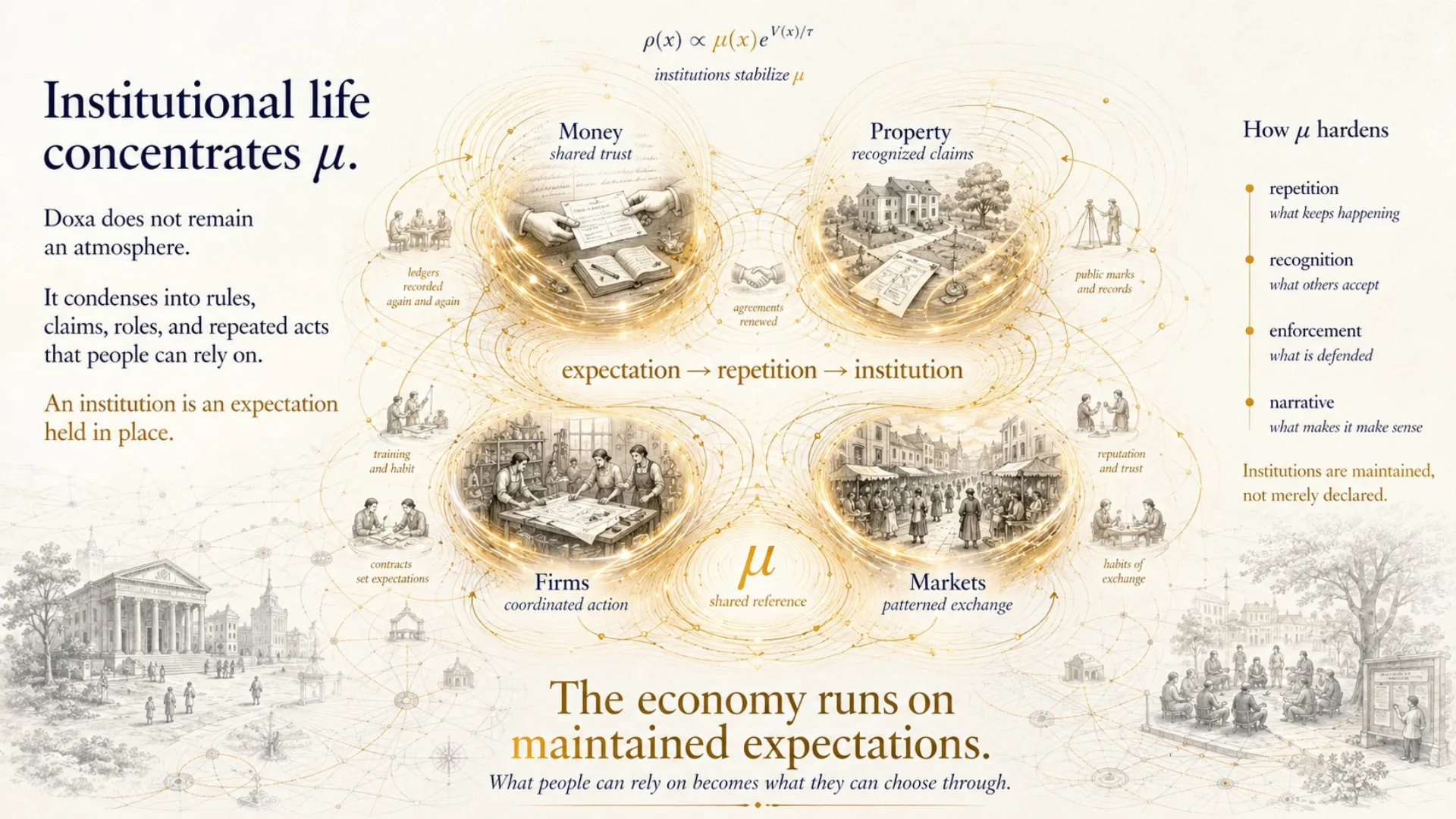
Money is a maintained concentration of μ in the medium-of-exchange domain; property, in resource ownership; a firm, in production organisation; a market, in coordination. Each is one operation, a maintained concentration of the reference, applied to a different slice of the configuration space. This is the formal substrate institutional economics from Veblen through North has wanted.
And the concentration requires maintenance, because the same informational logic that drives physical entropy applies to the reference: unattended, μ relaxes back toward its scaffolding. Institutions decay unless work is done, enforcement, ritual, reproduction, narrative, all of which pay the cost of holding a concentration of μ against drift.
Form is forced; content is earned
One distinction governs the whole paper. The chain forces the form: that there is a reference, that value tilts it exponentially, that the dynamics is the relaxation. It does not force the content of the slots. The identification of μ's social levels with doxa is a content claim, held to a stated standard, an identification earns its keep only when the structure's remaining machinery transfers and yields constraints the source field did not build in. The recoveries in Part IV are that test, run.
Doxa is what nobody argues about because the disagreement would not register.
The takeawayInstitutions are maintained concentrations of μ. Deviation from them carries the same KL cost that is thermodynamic in the physical case, deviation is costly, maintenance requires work, and neglect leads to decay.
From the paper
The framework's specifically economic content is the identification of the social levels of the reference measure μ with the community's doxa: the unspoken background of expectation that constitutes a shared social world, the upper part of a measure constructed hierarchically by successive maximum-entropy projection from raw possibility through symmetry, salience, institutions, and history. Institutions are maintained concentrations of μ. The cost of deviation from doxa is the KL term in the variational objective, the same cost structure that is thermodynamic in the physical-computation case and carries the same formal properties in the social one: deviation is costly, maintenance requires work, and neglect leads to decay.
§4.1 · The foundational claim of intelligent economics
The one identification that makes the forced substrate specifically economic.
From the book
A social norm is a highly compressed algorithm for successful behavior.
The Last Economy, ch. 13
The book names; the paper derives. Voice, not a second source of authority.
Part III · Doxa06 / 16
Four capitals, read off three costs
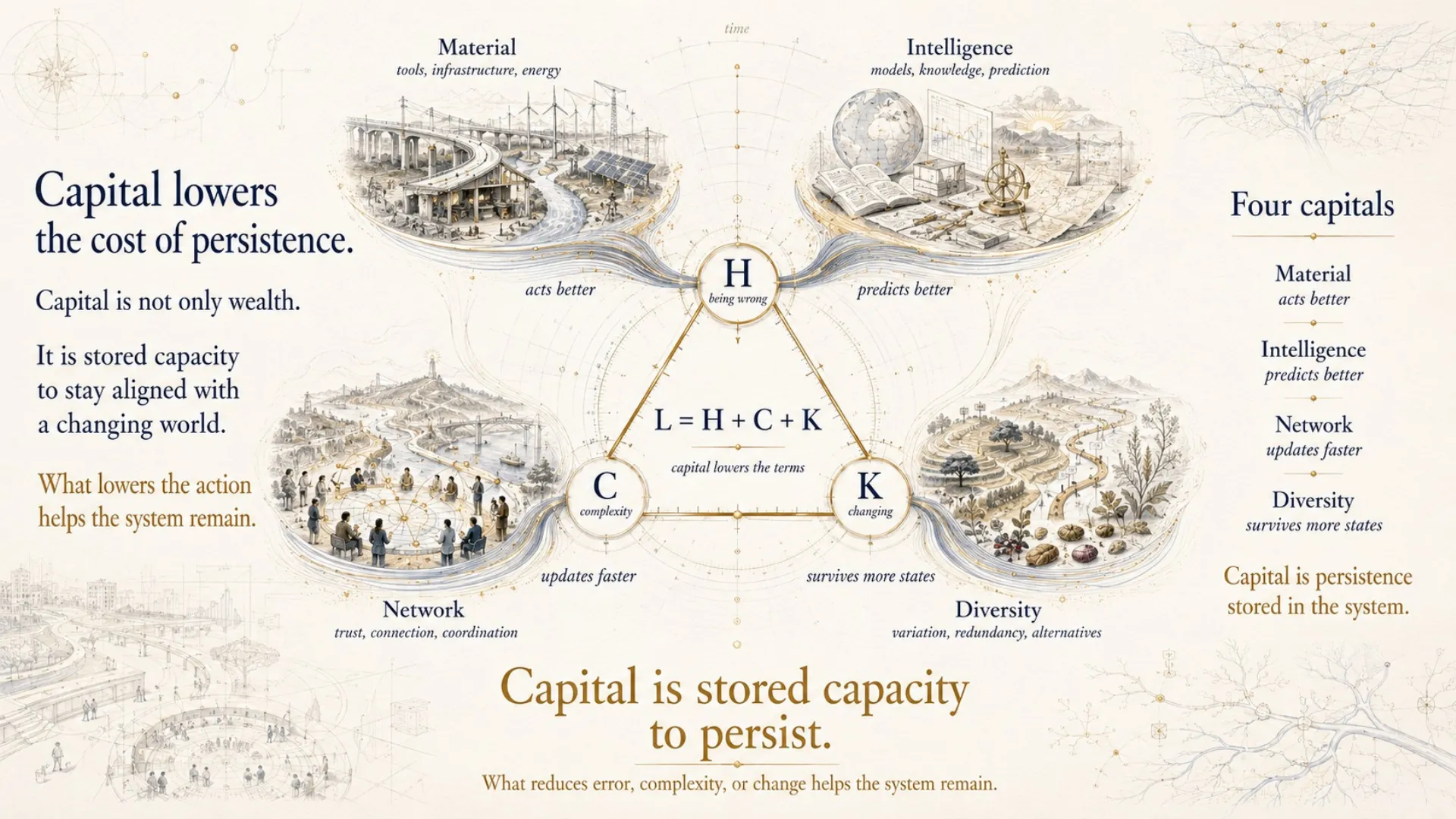
What does a community accumulate to lower the action? Each cost term names its own stock, and the value term takes two inputs that do not substitute, which is why there are four capitals and not three.
In plain wordsWhat should a community save up? Four things: stuff, know-how, connections, and variety. Miss any one of them and the other three can't save you.
The multiplicative picture, derived
The four-capital picture, where total capacity is a product, and any factor at zero collapses the whole, is the three cost terms counted as the stocks that lower them, with one modelling step: accurate prediction takes data and patterns as distinct, non-substituting inputs. Both zero-laws are theorems of the structure: a truth the reference excludes is unrecoverable at any evidence, and a constant V leaves choice exactly at μ, no prediction beyond what was already carried.
The value function V is deliberately not among the capitals: V is what the system is trying to bring about, the end, not a means. One does not accumulate an objective; one pursues it with the capitals the structure provides.
The derivation: stocks that lower the action
Read each cost as the stock that lowers it. There are three costs, but the being-wrong term takes two inputs that do not substitute, so four capitals, not three.
- 01
H splits into two inputs
Accurate prediction needs both data to read the world and patterns to interpret it, and neither substitutes: data without patterns is an uninterpreted warehouse; patterns without data are ungrounded speculation. That one modelling step is why there are four capitals, not three.
H ↓ by Material (data) × Intelligence (patterns)
- 02
K is lowered by connection
The cost of changing falls when a correction can propagate through shared channels and relationships, so no agent pays the full cost of moving alone.
K ↓ by Network
- 03
C is lowered by spread
A monoculture minimises complexity in the expected case but pays unboundedly when the unexpected arrives. A spread of references and strategies keeps the fragility cost finite across states.
C ↓ by Diversity
H, C, K ⟶ Material, Intelligence, Network, Diversity
The mapping is forced by the algebra, three terms and four inputs, with one modelling step. Value V is not a capital: it is the end, not a means, and you do not accumulate an objective.
| Capital | Lowers | What it is | Why it is irreducible |
|---|---|---|---|
| Material | H, being wrong | The data and physical substrate from which the world is read and acted on | Material without intelligence is a warehouse of uninterpreted facts |
| Intelligence | H, being wrong | The patterns and models that turn data into prediction | Intelligence without material is ungrounded speculation, and it is the one stock not depleted by use |
| Network | K, changing | The connective structure through which corrections propagate without each agent paying the full cost of moving alone | With no connection, nothing can be coordinated |
| Diversity | C, fragility | The spread of strategies and references the community carries | A monoculture minimises C in the expected case and pays unboundedly when the unexpected arrives |
The takeawayCapital is stored capacity to persist. Any one capital at zero zeroes the whole: no substrate, nothing to read; no patterns, nothing predicted; no connection, nothing coordinated; no diversity, fragile to the first unmodelled shock.
From the paper
The capitals that lower the action map onto its terms. Material and intelligence capital lower H, the cost of being wrong, as the two non-substituting inputs to an accurate model, data and patterns. Network capital lowers K, the cost of changing, as the connective structure through which updates propagate. Diversity capital lowers C, the cost of fragility, as the spread that keeps the complexity term finite when conditions shift. Achievable value requires all four: with no substrate there is nothing to read or act on, with no patterns nothing can be predicted, with no connection nothing can be coordinated, and with no diversity the system is fragile to the first shock outside its model, so any one missing is fatal regardless of the others.
§4.3 · Result: the four capitals are the three cost terms, read as stocks
Why there are four capitals and not three, and why any one at zero zeroes the whole.
From the book
These four capitals do not add. They multiply. M × I × N × D = Civilizational Vitality. This means a zero in any category equals total system failure, regardless of the other three.
The Last Economy, ch. 8
The book names; the paper derives. Voice, not a second source of authority.
Part III · Doxa07 / 16
Flow, openness, resilience
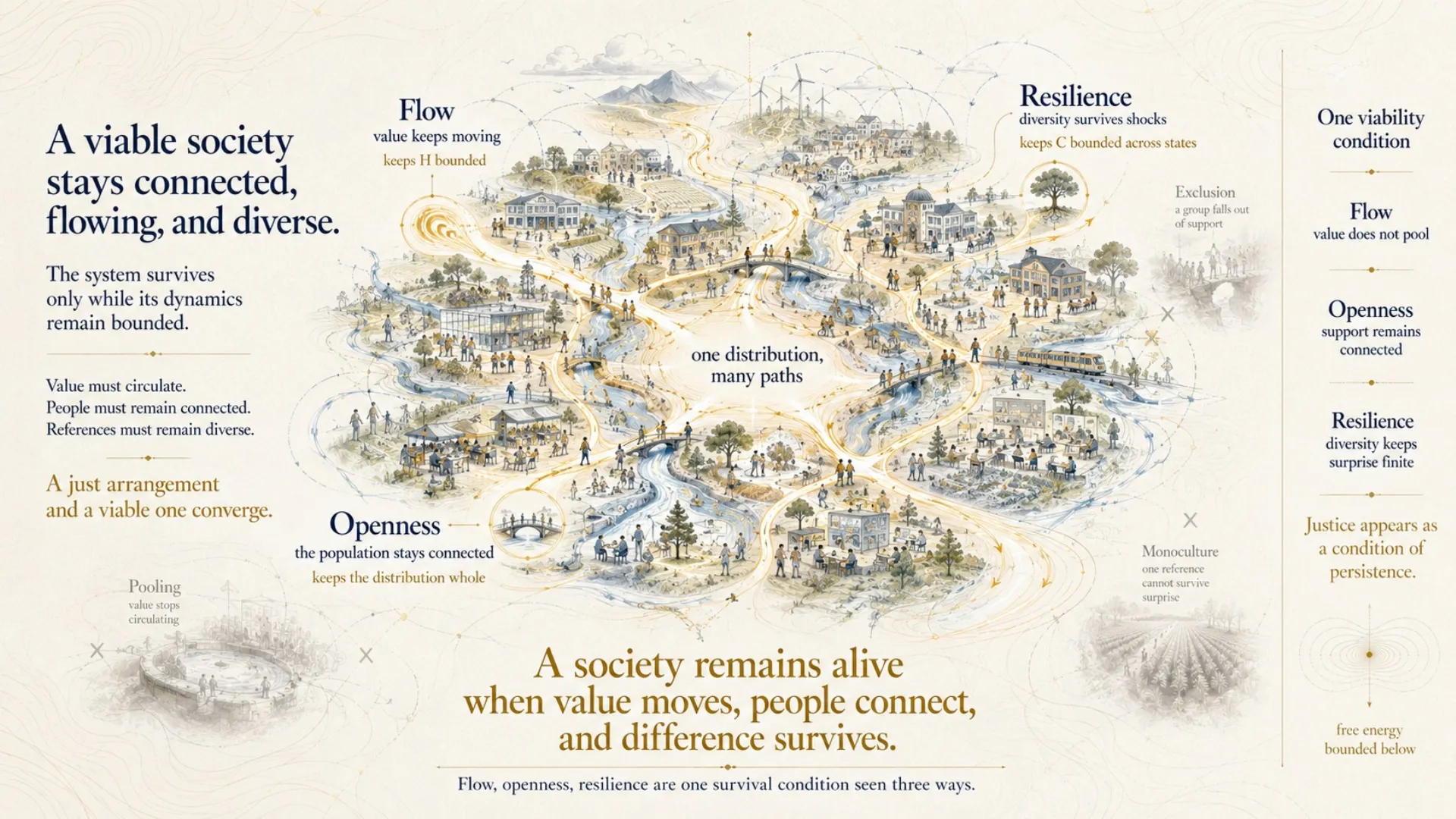
A community's dynamics stays alive only while its free energy remains finite and bounded below. That single condition, read once per cost term, yields the three laws of viability, and recovers the concerns of welfare economics without importing them as axioms.
In plain wordsA community stays alive by keeping value moving, keeping everyone inside the story, and keeping more than one way of seeing things. Lose any of the three and the maths itself breaks.
Flow, and resilience
Flow: the value term must stay bounded, value must keep moving through the population rather than pooling out of the dynamics. A system that consumes its capital without accounting lets its model diverge from reality; one that conserves but does not circulate stops generating the data that tests its predictions, and its model goes stale.
Resilience: the complexity term must stay bounded across states of the world, which requires diversity. A population holding a spread of references pays at worst the log of the weight on the component matched to the realised state, a finite price no matter how surprising the state. The monoculture pays without bound.
Openness is the sharpest of the three
For the dynamics to carry the whole population to one attractor, ρ must remain a single connected object, and connectedness can fail two ways. Exclusion is absorbing in the exact case: where the community's reference assigns a subpopulation's configurations zero probability, the relaxation cannot create mass there, so once the doxa stops recognising a group, the exclusion is self-reinforcing. Detachment is divergent: a group whose realised distribution leaves bounded KL of the shared reference falls out of the community's attractor.
A society that drives part of its population below viability has not committed an injustice named from outside the framework; it has fragmented its distribution into disconnected components and lost the ergodicity that let one dynamics carry everyone. Flow secures dignity; openness secures capability in the welfare tradition's sense; resilience secures survival of the shocks that were not modelled.
History keeps the receipts. Cahokia, larger than London in 1250, emptied within a generation of its wealth ceasing to circulate. Tokugawa Japan sealed itself for two centuries and bought stability at the price of stagnation. The Gros Michel banana, a perfect monoculture, was annihilated by one unmodelled fungus. Flow, openness, resilience: each law has a civilisation-sized counterexample.
A small but positive reference keeps the system open: the formal difference between neglect and exclusion.
The takeawayThe failures moral traditions condemn first, exclusion above all, are failures of viability as well. Fairness enters not as an imported axiom but as an operational requirement.
From the paper
For the gradient flow to carry the whole population to one attractor, ρ must remain a single connected object, and connectedness can fail in two ways, each a way of closing the system off. Exclusion is absorbing in the exact case: the support of the stationary target ρ* ∝ μ·e^(V/τ) is the support of μ, so where the community's reference assigns a subpopulation's configurations zero probability, the relaxation defined on that support cannot create mass there and the excluded cannot be drawn back. Once the doxa stops recognising a subpopulation, the exclusion is self-reinforcing; a small but positive reference keeps the system open: the formal difference between neglect and exclusion.
§4.4 · Result: openness is the connectedness of the distribution
Where a moral commitment is derived as a viability requirement of the dynamics.
From the book
Openness is not an ideological preference; it is a physical requirement for staving off systemic death.
The Last Economy, ch. 7
The book names; the paper derives. Voice, not a second source of authority.

Part IV
The Recoveries
The framework does not replace the century. It locates it.
Part IV · The Recoveries08 / 16
Classical economics, recovered at its limits
A claimed foundation has to answer for the economics that already exists. The classical results are special cases of the object, each recovered at the limit its field assumed, each correction appearing when the reference is restored.
In plain wordsThe economics you learned in school isn't wrong, it's this one formula with some dials taped in place. Untape a dial and the textbook result comes back with a correction attached.
Watch one equation become four literatures
Each film starts from the forced object ρ ∝ μ·eV/τ and applies only the assumption the classical field made, a linear tilt, a flat reference, a vanishing temperature, a no-arbitrage constraint.
forcedA linear price tilt makes demand an envelope derivative, and Slutsky symmetry and negativity fall out of the convexity of log Z, with no utility posited.
The derivations shown are the paper's (§5); the drawn landscapes, sample paths, and pacing are illustrative. Films render offline frommanim/recoveries.py, regenerate them if the argument changes.
The recoveries, animated: each film starts from the forced object and applies only the assumption the classical field made, a linear price tilt (demand and Slutsky), a flattened reference (the logit), a vanishing temperature (Nash, Arrow–Debreu, rational expectations), a no-arbitrage tilt (Black–Scholes). The derivations are the paper's; the drawn landscapes and pacing are illustrative.
The mainstream and the heterodox, located
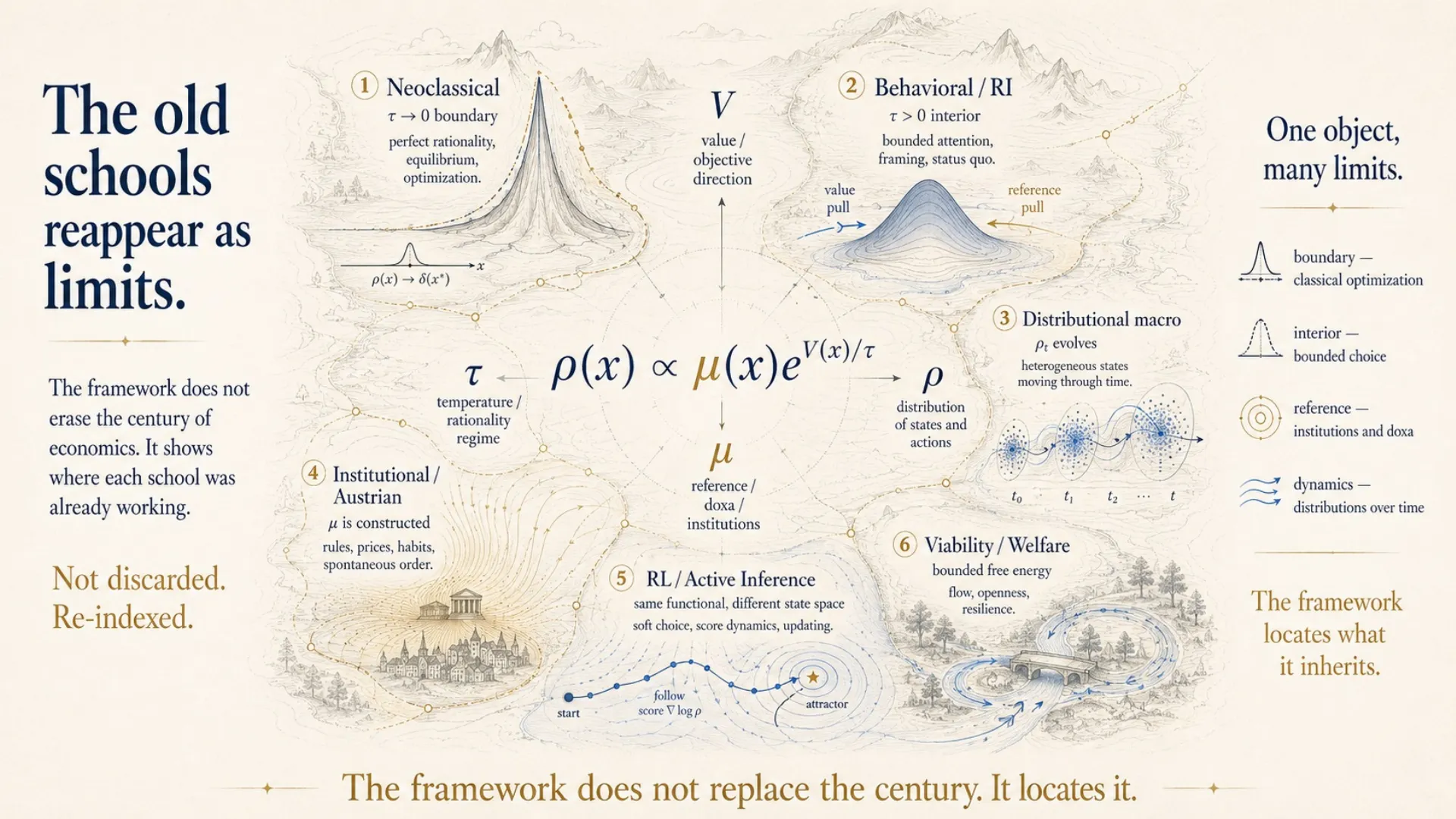
Neoclassical and Walrasian economics is the zero-temperature limit: perfect rationality, frictionless equilibrium, concentration on the value-maximising configurations. Behavioural economics and rational inattention are the contractive regime, the finite-temperature form, taken seriously, anchoring, status-quo bias, and framing effects are different names for the score's pull toward μ. Marxian economics is the circulation-dominant regime of the population dynamics: where values are non-reciprocal, part of the motion runs in closed loops rather than toward the attractor, the same circulating component whose machine-learning face is the cycling of adversarial training. And institutional economics emphasises the construction of μ itself: Hayek on spontaneous order is emergent doxa construction; North on institutions is Level 3 of the hierarchy.
The framework does not adjudicate between the schools; it locates them. Each is doing economics on a different part of the same object: the mainstream on the boundary, the heterodox in the interior, the institutionalists on the reference the structure is defined against.
| Classical result | Recovered as | What the field assumed | What the reference adds back |
|---|---|---|---|
| Demand & Slutsky symmetry | Gradient of the log-partition function under a linear price tilt | A price-independent reference | Measured Slutsky asymmetry becomes an estimator of the reference's price dependence, doxa acquires an empirical handle |
| McFadden's logit | The object on a finite uniform support | τ as a fitting constant | τ is an information price, not a free parameter |
| Black–Scholes | The Girsanov exponential tilt of the physical measure, fixed by no-arbitrage | Complete markets | The tilt's relative-entropy cost has the same form as the complexity cost C |
| Euler equation | First-order conditions of the τ→0 mode on contingent plans | Perfect rationality | At finite τ, the definite correction −τ·∇log μ: the doxic score at the price of information |
| Coase theorem | Cheap reallocation reaches ρ* from any start | Frictionless bargaining | When reallocation is dear, the relaxation is slow and path-dependent, initial allocations matter |
| Nash equilibrium | The τ→0 corner of quantal response equilibrium | Exact best response | QRE exists for every τ>0 by a cleaner argument than Nash's own |
The test that separates a contentful identification from an empty one is transfer: a renaming transfers nothing and predicts nothing.
The takeawayThe pattern is one move: a classical result is the choice object under the reference and limit its field assumes, and its corrections are what restoring or evolving the reference returns.
From the paper
The pattern, here and in the deferred recoveries, is one move: a classical result is the choice object under the reference and limit its field assumes, and its corrections are what restoring or evolving the reference returns. Static demand at a price-independent reference gives Slutsky symmetry; a price-dependent reference adds the doxic asymmetry. The physical measure tilted to no-arbitrage gives Black–Scholes. And a reference that relaxes at finite rate gives the Lucas critique its missing equation of motion. The unifying fact is structural: bounded-rational choice, the risk-neutral measure, and the maximum-entropy logit are one object, the unique exponential tilt of a reference fixed by a constraint, and the classical equations are what it yields under the references each field assumes.
§5.1 · Result: recovery is the reference, flattened or evolved
The one move behind every recovery in the section.
From the book
The neoclassical economists were not fools; they were brilliant mathematicians studying the physics of a perfect, platonic ideal. Their tragedy was mistaking that beautiful, simple ideal for the messy, curved, and dynamic reality we inhabit. They gave us a perfect map of a world that does not exist.
The Last Economy, ch. 9
The book names; the paper derives. Voice, not a second source of authority.
Part IV · The Recoveries09 / 16
Expectations get their equation of motion
Lucas said estimated policy relationships shift because expectations adapt. Rational expectations answered by assuming the adaptation is instant. The framework supplies what was missing: expectations live in μ, and the dynamics says exactly how μ moves.
In plain wordsPeople adjust to new rules, so yesterday's patterns stop working the moment you lean on them. The paper turns that old warning into an actual equation, the same one that explains why AIs trained on their own output go stale.
One map, three literatures
Within a round: tilt the reference by the payoff, ρ* ∝ μ·e^(V/τ). Across rounds: absorb the tilt, μ ← ρ*. Run it and watch the reference narrow.
- Round
- 0
- Entropy of μ
- 5.21nats · falling
- Tail mass beyond ±2σ of the peak
- 12.5%
Three literatures, one iteration. (1) Expectations adjusting to a policy change, the equation of motion the Lucas critique says is missing. (2) Adverse-selection unravelling (Akerlof), the same loop with a support-restriction step. (3) Model collapse when a generative model trains on its own output (Shumailov 2024), switch on sampling noise and the tails die irreversibly: no later tilt can resurrect a region of zero measure. Same map every time: tilt, then absorb.
The update μ ← ρ* with ρ* ∝ μ·e^(V/τ) isforced; reading Lucas, Akerlof and model collapse as instances of it isidentified; tail-loss under self-training is empirical(Shumailov 2024). The particular V, τ, the two-bump μ₀ and the 200-draw resample are illustrative.
The across-round iteration μ ← ρ*, run live. Each round tilts the reference by value, then absorbs the result. Iterated under a fixed objective it anneals toward a point mass, long-run rational expectations, and the doxic monoculture whose fragility Part VI prices. Add finite sampling and the tails die irreversibly: model collapse. The map is forced; the landscape is illustrative.
The dichotomy was never real
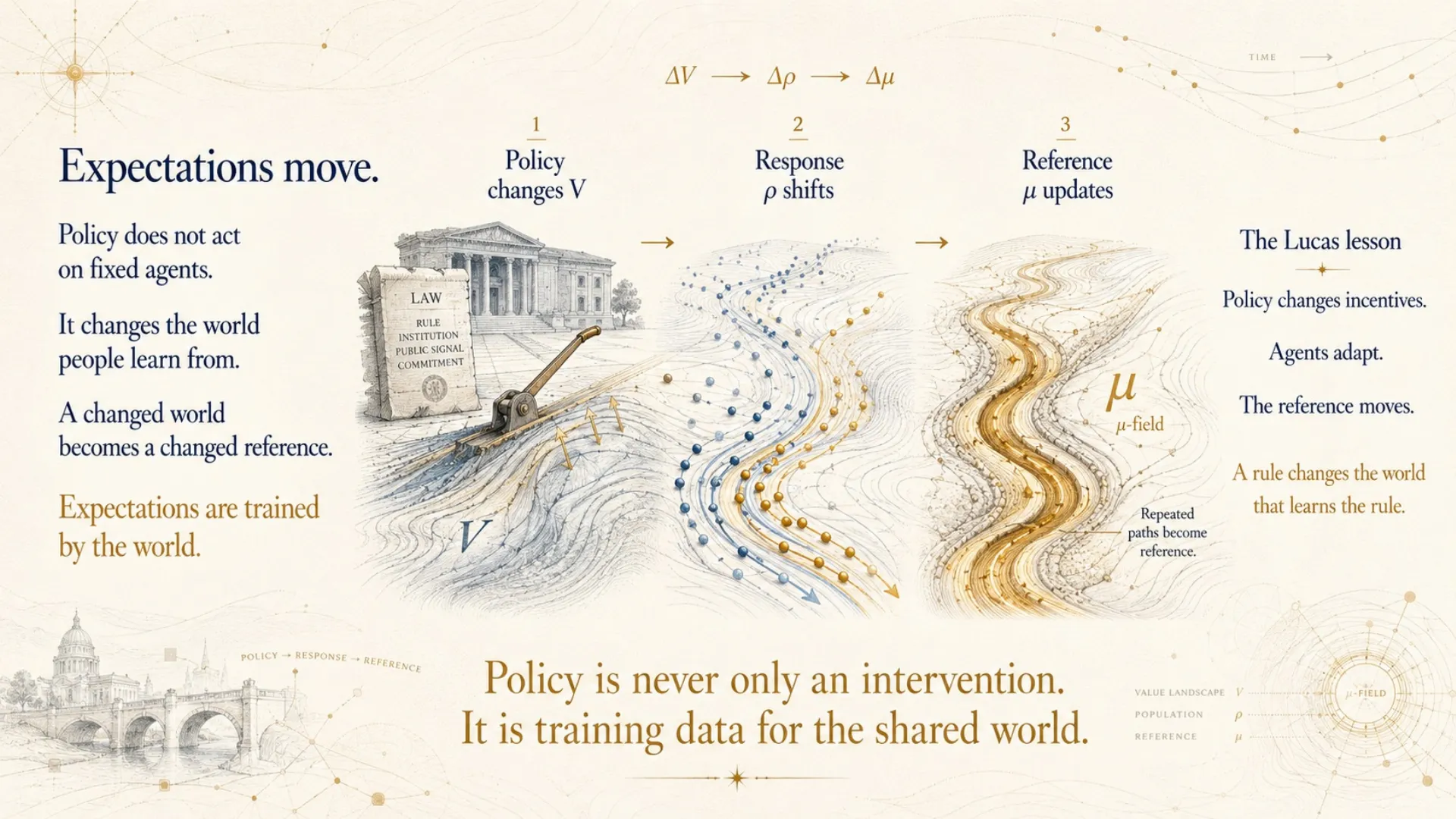
The standard treatment faces a choice between fixed expectations and instantly rational ones. These are the two limits of one relaxation: a policy change is a change in V; within a round the realised distribution relaxes toward the new ρ* at a finite rate set by τ and the geometry of the score; across rounds the reference absorbs what the relaxation reached. The Lucas critique, the statement that μ is not policy-invariant, becomes a parameter to be measured rather than a prohibition on policy analysis.
The same map runs the market for lemons, and model collapse
In Akerlof's market for quality, the market for lemons, the buyer prices average quality under the current reference, sellers above the price exit, and the reference updates to the survivors: the same iteration with a support-restriction step. The repair is the openness law applied to markets, warranties and disclosure are support-pinning devices, holding open by commitment the region the iteration would otherwise shed.
Run the iteration on a system's own output and it is the noiseless skeleton of model collapse in generative models: finite sampling loses the tails, and the next reference can no longer restore them. Reward over-optimisation is the fixed-V case. What macroeconomics, market design, and machine learning have each documented separately is one map.
The derivation: expectations get an equation of motion
The Lucas critique says estimated relationships shift because expectations adapt, but never says how. The chain supplies the how, on two timescales.
- 01
A policy change is a change in V
A regime shift enters the object as a new value function. Nothing else in the form changes.
policy shift ⟹ new V
- 02
Within a round, the distribution relaxes
Holding the reference μ fixed, choices relax toward the new target by the same canonical diffusion from the chain, at a finite rate set by τ.
dX = ∇log ρ⋆ · dt + √2 · dW, ρ⋆ ∝ μ·e^(V/τ)
- 03
Across rounds, the reference moves
What a settled round leaves behind is what the agent brings to the next, so the reference absorbs the relaxation. This is not chosen; it follows from what μ means. Iterated under a fixed policy it anneals toward the optimum, long-run rational expectations as a limit, not an assumption.
μ ← ρ⋆
within round: relax to ρ⋆ · across rounds: μ ← ρ⋆
The old dichotomy, fixed versus instantly-rational expectations, is just the slow and fast limits of one relaxation, and the adaptation rate is estimable. The same μ ← ρ⋆ run on a system’s own output is model collapse in generative models.
One map wearing three literatures.
The takeawayPolicy is never only an intervention, it is training data for the shared world. Across rounds the settled distribution becomes the next reference, μ ← ρ*, and the adaptation rate becomes a parameter to measure rather than a prohibition to obey.
From the paper
A policy change is a change in V. Within a round, the realised distribution relaxes toward the new target ρ* ∝ μ·e^(V/τ) by the overdamped Langevin diffusion of Link 4 … at a finite rate set by τ and the geometry of the score; across rounds, the settled distribution becomes the updated reference, so μ itself moves by absorbing what the relaxation reaches. … The Lucas critique is the statement that μ is not policy-invariant, and the two steps together provide an equation of motion for the adjustment of expectations the critique says is missing.
§5.1 · Result: expectations relax to the new equilibrium
The equation of motion the critique said was missing, in two steps: relax within a round, absorb across rounds.
From the book
The Lucas Critique is what AI engineers call 'distributional shift.' They have been building systems to handle it for years. Economists are just beginning to catch up.
The Last Economy, ch. 13
The book names; the paper derives. Voice, not a second source of authority.
Part IV · The Recoveries10 / 16
Why polarisation resists evidence
The structure scales from one agent to a population by assembly: couple through V and you get games; couple through μ and you get agreement and aggregation. The modern failures of both live in the second coupling.
In plain wordsWhy do smart people disagree forever, even with the same facts? Because facts are read against a background, and when backgrounds differ, more facts don't help.
Agreement needs a shared reference, literally
Aumann's theorem says Bayesians with a common prior cannot agree to disagree. In the structure the mechanism is one step: with μ shared, each agent reads the other's evidence off the ratio ρ/μ, and the exponential form multiplies the tilts into one posterior, on a hypothesis stronger than Aumann's own, and the framework's yield is the phenomenon and its failure mode. When references differ, the extraction breaks at the first step, the ratio is no longer the tilt, and no amount of exchanging posteriors repairs a difference in the reference they are read against.
The same machinery recovers Condorcet exactly, and locates its failure: each voter's doxic bias is systematic where the signals are noisy, so it does not wash out with n. Whenever mean bias exceeds what a signal carries, the aggregate converges confidently on the wrong answer no matter how many signals arrive. Polarisation is a failure of shared doxa, located below the level of argument, in the reference against which arguments are heard.
Polarisation resists repair by more evidence, because evidence is processed through the reference; it is repaired by rebuilding the common μ.
The takeawayPersistent disagreement is a doxic phenomenon. The common-prior assumption is the assumption that agents share a doxa, and the empirical ubiquity of persistent disagreement is evidence that they do not.
From the paper
The chain forces the structure per agent. Each agent independently satisfies it with its own V_i, μ_i, and τ_i; multi-agent results require no new axioms, because the coupling runs through the inputs the chain leaves free. Coupling through V, when each agent's value depends on the others' choices, gives strategic interaction and its equilibria. Coupling through μ, when agents share or differ in their references, gives agreement, aggregation, and the maintenance dynamics. The structure scales from one agent to a population by assembly, not by extension, which is why the same object governs a single chooser, a game, a market, a training pipeline, and the community whose doxa all of these act against.
§5.2 · Result: the structure scales by assembly
Why agreement, juries, and polarisation need no new axioms, only couplings through V and μ.
Part IV · The Recoveries11 / 16
The market clears, the firm coheres
Couple the agents through one shared scarcity constraint and the price appears as its multiplier; clearing becomes a convex program; welfare gets a theorem at temperature. And the firm, Coase's island of conscious coordination, turns out to be a maintained reference with a residual claimant.
In plain wordsPrices aren't handed down from anywhere, they show up on their own when everyone's choices have to share one world. And a company is just a group that shares its background so deeply it doesn't need prices inside.
Clearing as a convex program (§6.1): aggregate excess demand is the negative gradient of Φ(p) = Σ τ_a·log Z_a(p) + p·ω, so tâtonnement is a ball rolling down a convex bowl, and the textbook crossing of supply and demand is the same minimiser, seen as two convexities facing each other across one constraint.
The price, derived at last
Everywhere earlier, the price entered as a coordinate of V, given from outside. Couple each agent's forced problem through a shared resource constraint and the multiplier on that constraint enters every stationarity condition identically: the price is to scarcity what the temperature is to information, both are Lagrange multipliers. Supply slopes up by the same convexity that makes demand slope down, and the textbook crossing is two convexities facing each other across one constraint.
The classical pathologies acquire an address: cooling τ→0 collapses the curvature into the kinks where non-uniqueness and instability live; restoring income effects breaks the gradient structure itself, which is where the Sonnenschein–Mantel–Debreu indeterminacy lives. And the transfer test is passed by the field's own practice: entropy-regularised equilibrium is exactly how computational economics solves matching markets and how machine learning computes optimal transport.
The firm is a maintained μ
A firm is a deliberately built and continuously maintained reference, joined to a value function its members adopt within a zone of acceptance, and a residual claimant who owns the difference. Inside a shared reference, tilts are mutually legible and coordination is cheap, firms are agreement zones; across references only the price survives as a common signal. Employment is Simon's contract with enculturation inside it: onboarding is reference transfer, its cost denominated in units the paper already carries. The folk theorem that culture eats strategy is the two-factor result in the vernacular.
Knight's entrepreneur holds a private μ that cannot be articulated into a contract, the firm is the container of that bet. And inward, the exclusion law applies unchanged: configurations the corporate reference excludes are unreachable at any internal incentive. That is the innovator's dilemma as a one-line identity, and it predicts the observed repair exactly, firms that survive disruption spin out units with separate references, reference-rebuilding being the only cure the theorem admits.
Incumbents fail against entrants they can see, with resources they have, because no bonus creates probability where the reference has none.
The takeawayAn allocation is efficient against a given doxa: a group whose reference excludes some goods receives no weight there at any price, and the outcome still certifies as efficient. The welfare theorems are doxa-conditional, Pareto is blind to μ.
From the paper
On compactly supported references with the endowment interior to the aggregate achievable set, Φ is finite, smooth, and coercive, so equilibrium prices exist as its minimiser, are unique whenever the covariance Hessian is non-degenerate, and tâtonnement, prices adjusting along excess demand, is a gradient flow that converges globally to them. A producer facing the same price supplies with slope ∂y*/∂p = +Cov(y)/τ ⪰ 0: supply slopes up by the same convexity that made demand slope down, and the textbook crossing is two convexities facing each other across one constraint.
§6.1 · Prices, supply, and welfare: clearing as a convex program
The textbook's first picture, two curves crossing, derived rather than drawn.
From the book
The market discovers. The firm executes. A healthy economy needs both.
The Last Economy, ch. 11
The book names; the paper derives. Voice, not a second source of authority.
Run the model
The framework, in figures you can move.
Four mechanisms from the paper, parameterised. The mechanisms are derived; the landscapes and rates are yours to move, the paper's claim is the structure, not a timetable.
The two regimes
One law, ρ(a) ∝ μ(a)·e^(V(a)/τ). One dial. Two economics.
The law is forced, the unique solution of the bounded choice problem; only μ and τ are free. High τ is the behavioural register: anchoring and status-quo bias are the pull of μ, agents doing what is expected. τ→0 is perfect rationality, valid as an idealisation, misleading as empirics. The values V and reference μ here are illustrative numbers; only the mechanism is the paper’s.
The crossing
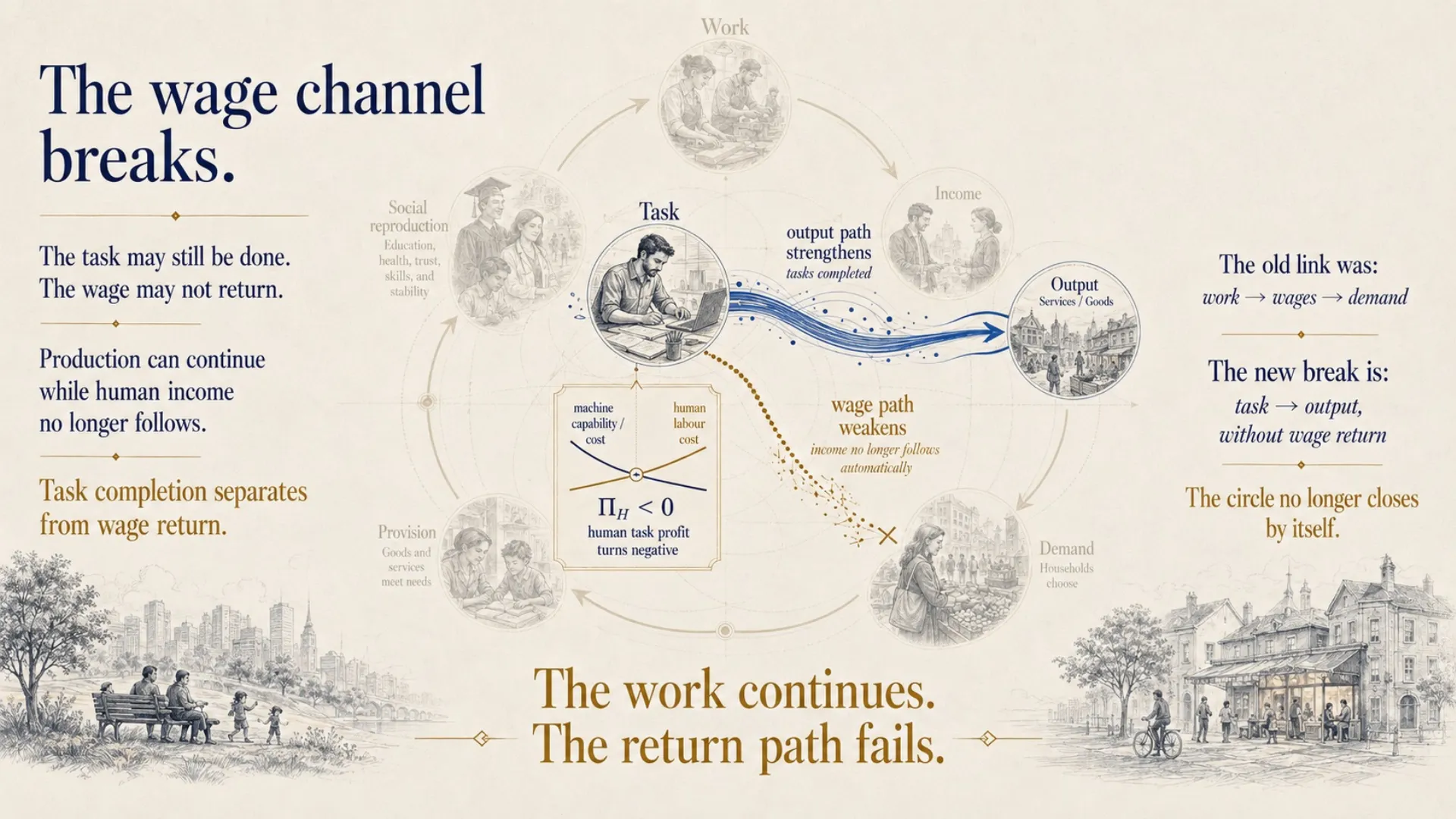
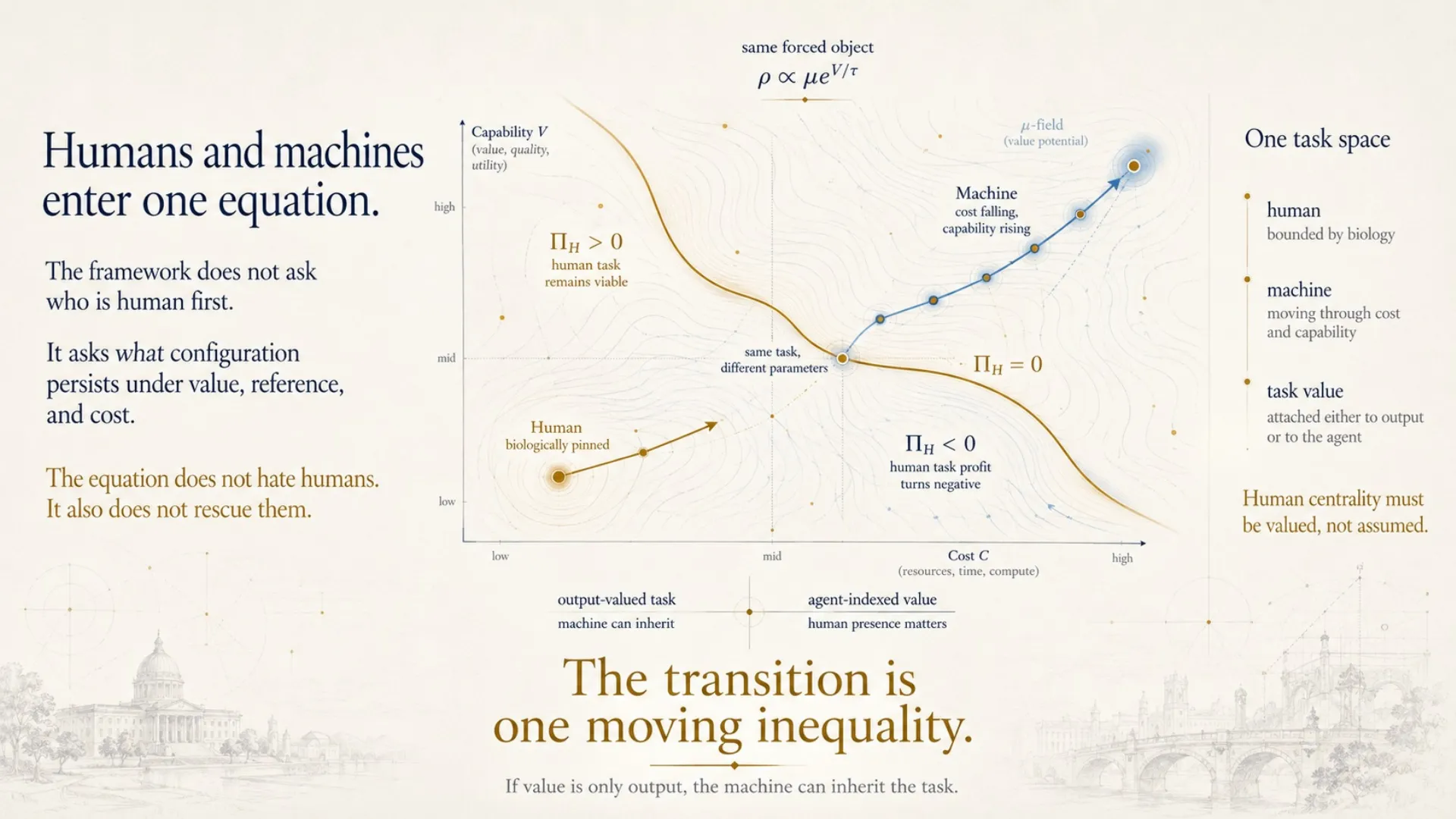
Π = capability − cost, both sides. The human line cannot move; the machine lines will not stop.
capability past the human
The mechanism is derived: no term of Π reads “human”, and the human cost term is pinned by metabolism, a 20 W brain, ~100 W of sustained muscleempirical, so the wage that provisions a worker is floored by subsistence identified. The starting values (machine at 60 vu capability, 90 vu cost at t₀) and the rates g and d are illustrative pedagogy, yours to move: the paper claims the structure of the crossing, not its date.
Aggregation and its failure
n voters, one truth, a shared reference, until the reference tilts.
at n = 101
With b below the threshold this is Condorcet, 1785empirical, recovered exactly under a shared reference. The failure condition, mean bias exceeding ln(p/(1−p)), is read off the same structureidentified. Polarisation then resists repair by evidence, because evidence is processed through the reference; the repair is rebuilding the common μ, not adding voters. The slider values are illustrative; the inequality is not.
Make, or buy
Every transaction pays a tilt across the reference gap, unless someone maintains the reference.
Coase (1937) priced this boundary as accounting; here it is primitive, the firm is a maintained μ with a residual claimant, the market a per-transaction tilt across reference gapsidentified. The AI corollary: a fleet of instances of one model copies its reference for free, M→0 at Δ_in→0, so both poles collapse at once, giant single-reference firms and thin agent markets; the free shared reference is a monoculture, and the resilience law prices the winning design. τ, Δ, M and the transaction counts here are illustrative numbers; only the crossing is the mechanism.
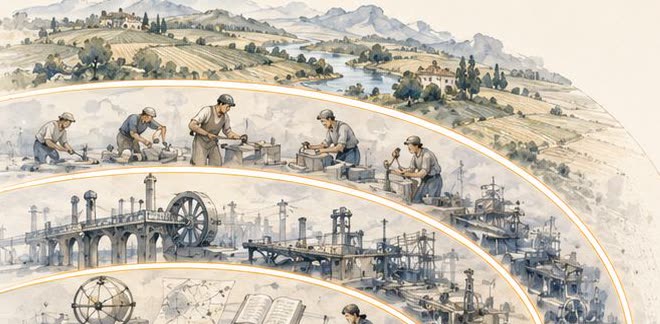
Part V
The Last Economy
When action is cheap, the scarce factor is what action means.
Part V · The Last Economy12 / 16
The Metabolic Rift
The kinematics is substrate-independent, the same in neurons and in silicon. What differs is the cost of instantiating an agent that runs it. The effective temperature that governs economic behaviour combines the two: τ_eff = τ_info + p·c_sub.
In plain wordsA human brain runs on about twenty watts and can't go lower. Machines have no such floor. That one asymmetry, not any grand theory, is what makes this time different.
Two layers, one bridge
The temperature τ is, by the envelope theorem, the shadow price of information: value forgone per nat of deviation from the reference. It is not the cost of computation, which is energy per nat. An agent that must fund its own operation faces both, and to first order their combination is a sum: τ_eff = τ_info + p·c_sub, the information price the kinematics forces, plus the substrate's physics converted at the price of energy.
This decomposition, what the book names the Metabolic Rift, is where human and machine separate. For a human, c_sub is metabolic and has a floor biology cannot lower. For a machine, both terms are favourable: τ_info is a tunable sampling parameter, and c_sub falls toward its physical floor with each hardware generation.
The floor is not imported, it is derived
Erasing one bit takes a two-state distribution to a single state: against a uniform reference, that raises the KL divergence by exactly ln 2, and the complexity cost charges τ per nat. When the computation is physically instantiated and the reference is the physical Gibbs state, the information temperature is the thermodynamic one, and the cost is k·T·ln 2, Landauer's bound, recovered as the framework's own KL term rather than borrowed from physics.
So both floors are the same complexity cost the chain already forced: the machine's falls toward the Landauer margin; the human's sits far above it, metabolically pinned. Cost, however, is only half the comparison, capability is the other, and the object carries both.
A one-bit erasure costs τ·ln 2; physically instantiated, that is Landauer's bound.
The takeawayThe human's τ_eff has an irreducible metabolic component far above the physical floor; the machine's does not. This is the entry into the economy of labour whose cost has no metabolic floor.
From the paper
Erasing a bit takes a distribution supported on two equiprobable states to one supported on a single state. Against a uniform two-state reference this erasure raises D_KL(ρ‖μ) by exactly ln 2 nats, and the complexity cost C = τ·D_KL of the free energy charges τ per nat, so the cost of the erasure is τ·ln 2. When the computation is physically instantiated at temperature T with the reference taken as the physical Gibbs state, the information temperature τ is the thermodynamic temperature k_B T, and the cost is τ·ln 2 = k_B T·ln 2, which is Landauer's bound.
§7.1 · Result: a one-bit erasure costs τ ln 2, physically instantiated, that is Landauer's bound
The physical floor the machine's cost falls toward, and the human's metabolic cost cannot.
From the book
Capital needed labor, and labor needed calories. This was the great bargain. The Intelligence Inversion shatters this bargain. An AI does not need sustenance. A robot does not need shelter. They need electricity.
The Last Economy, ch. 18
The book names; the paper derives. Voice, not a second source of authority.
Part V · The Last Economy13 / 16
The sweep has no fixed point for the human
Human and humanoid are parameter vectors of one object, compared coordinate by coordinate on cost and capability. Every human coordinate is biologically pinned; every machine coordinate is falling toward it or rising past it. The framework reserves no coordinate the sweep cannot reach.
In plain wordsFor every job, ask two questions: is the machine cheaper, and is it better? Each job flips when both answers turn yes, and nothing in the maths reserves a job that can never flip.
The sweep across the plane
One equation, two axes. Human coordinates are pinned by biology; machine coordinates move, cost falls, capability climbs. Drag time forward and watch tasks flip quadrant in the order their profile sets.
- Displaced, ΠH < 0 identified
- 1of 14
- Held only by dexterity ηact identified
- 5tasks in the window
- Protected coordinates forced
- 0in the object
Cognitive tasks cross first. This wave automates K_compute beforeK_act, the inverse of every prior wave, Moravec's paradox made economic. At today's rates (25%/yr cost decline,12%/yr capability growth, scaled by profile), the manual trades are still safe on both axes.
The predicted window. 5 manual tasks are now cheaper to automate but clumsier, parked in “retained on capability”, held only by the dexterity premiumη_act. Actuation cost crossed parity before actuationcapability did; no other term protects them.
The frontier keeps sweeping toward the upper-left. The last holdouts,surgery, hairdressing, are held on capability, not cost: the highest-dexterity tasks, in exactly the order the profile predicts. Nothing in the object holds any of them forever.
What the paper derives forced is thedirection of the sweep: no term in the object reads “value the actor has because it is human”, so no coordinate is protected. The task profiles, rates and 20-year clock here are illustrativeidentified, the frontier's direction, not its timetable.
The transition as a two-axis sweep: each task sits at the humanoid's cost (horizontal) and capability (vertical) relative to the human, and the frontier moves from dear-and-unable toward cheap-and-able. Cognitive tasks crossed first; high-dexterity trades are held longest, on capability, not cost. The direction is structural; the timetable is illustrative.
The two standard defences, priced
Comparative advantage governs who does which task among agents whose surplus is positive; it does not make a negative-surplus agent profitable. When Π_H < 0 on a task, assigning it to the human by comparative advantage still loses money, the sweep removes the precondition, a positive surplus somewhere in the allocation.
The wage should fall until employment clears, and the decomposition locates the floor at which it cannot. The wage at which human work provisions its worker is bounded below by subsistence; once the machine's full cost falls beneath that floor, there is no market-clearing wage at which employment both clears and provisions. Work below the floor can persist, transfer-financed, or chosen for its own sake, but it no longer carries consumption, and it is the carrying of consumption whose severing matters.
The preview is already in the record: before 'computer' named a machine it named a job, and rooms of human computers carried the space race's arithmetic, until the IBM 7090 did a lifetime's work in an afternoon and the occupation vanished overnight.
The order is specific
On cognition the machine has crossed both axes, which is why routine cognitive work goes first, this wave automates the compute half of the kinetic cost and leaves actuation as the lagging human reservoir, inverting every prior wave. The two actuation axes cross at different times: cost falls before capability catches up, because a cheap actuator is easier to build than a dexterous controller. So the framework predicts a window in which humans are retained specifically for the dexterity premium even while undercut on cost. Digital intelligence, meanwhile, is the special case of embodied intelligence with the actuation channel set to null, and because cheap cognition is non-rival it competes its own price down, so the durable rents sit on the embodied side, where matter, energy, space, and wear keep marginal costs from vanishing.
What the framework recovers here is the task-based automation literature, displacement and reinstatement, with the boundary condition it left open: reinstatement draws on a reservoir of tasks where humans still hold an advantage, and the framework identifies that reservoir as the lagging coordinates, consumed in a definite order, ending at whatever agent-indexed value a community insists on.
The derivation: the machine’s cost floor
The complexity cost C, evaluated on a single bit at the physical temperature, is Landauer’s bound, so the machine’s floor is the same cost the chain already forced.
- 01
Erase a bit
Erasure takes a distribution on two equiprobable states to one on a single state. Measured against a uniform two-state reference, that raises the KL divergence by exactly ln 2 nats.
Δ D_KL(ρ‖μ) = ln 2
- 02
Price it at the complexity cost
The framework’s own C term charges τ per nat, so the erasure costs τ·ln 2. This is nothing but C applied to a one-bit support reduction.
C = τ·D_KL ⟹ cost = τ·ln 2
- 03
Instantiate it physically
When the computation runs at temperature T with the physical Gibbs state as its reference, the information temperature is the thermodynamic one, τ = k·T. The floor lands in magnitude.
τ = k·T ⟹ τ·ln 2 = k·T·ln 2
one bit erased ≥ k·T·ln 2
Landauer’s bound, recovered as C at the physical temperature rather than imported. A machine’s cost falls toward this floor; a human’s is metabolically pinned far above it, both the same complexity cost.
| Coordinate | Human | Humanoid |
|---|---|---|
| τ_info, information price | fixed by neural bound | tunable |
| c_cog, energy per nat, cognition | metabolic, fixed | falling to Landauer |
| c_act, energy per unit action | metabolic, fixed | falling |
| η_act, actuation capability | very high, evolved | low, rising slowly |
| r, throughput, no fatigue | fixed | tunable |
| E_ρ[V], cognitive capability | high, fixed | rising past human |
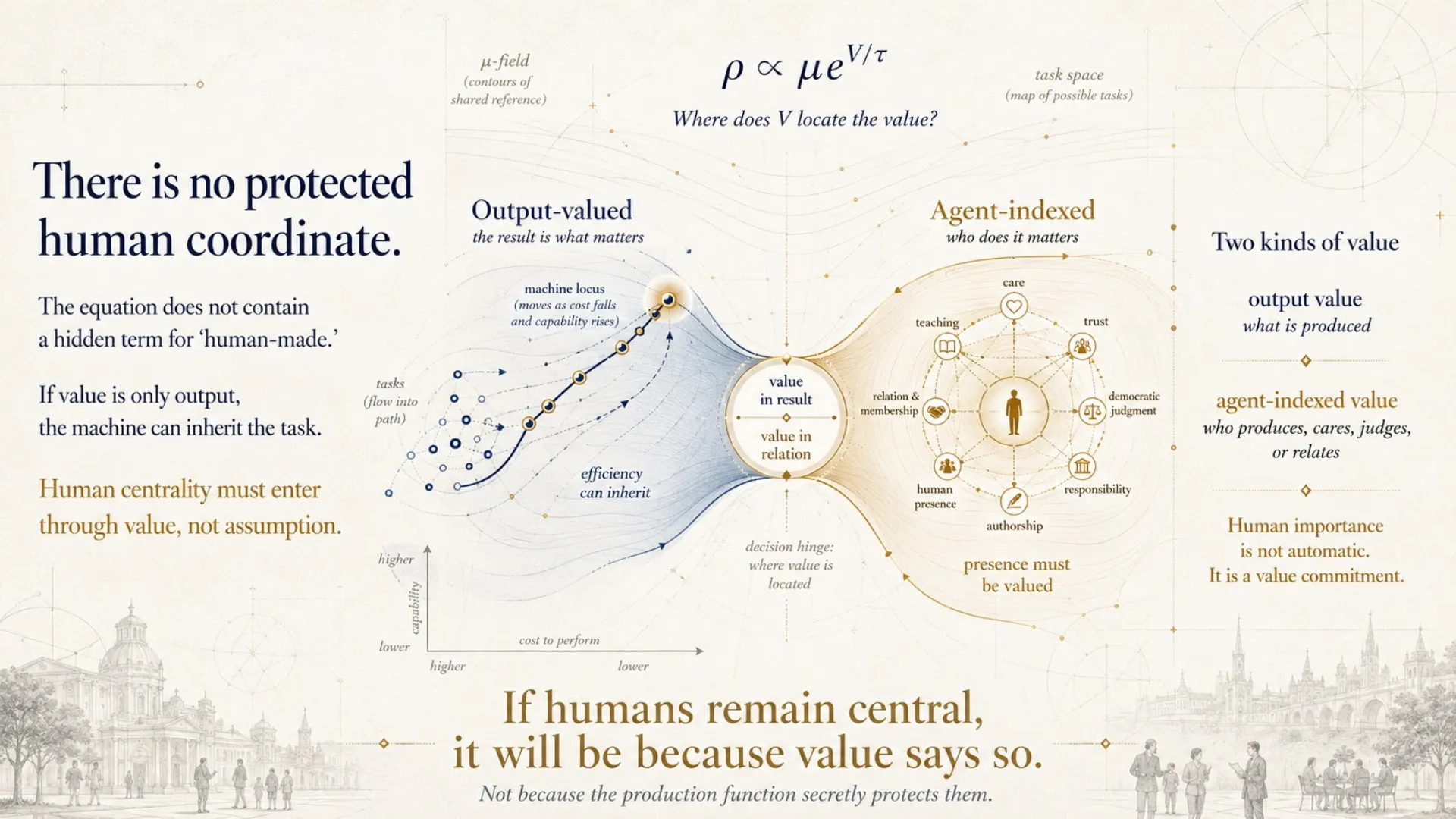
There is no term in the object that reads “value the actor has because it is human.” Such a term could be posited, but it would be exactly the kind of unfounded comfort this framework was built to do without.
The takeawayThe equation does not hate humans; it also does not rescue them. It fixes the endpoint, technology fixes the timetable, and if humans remain central, it will be because value says so, not because the production function secretly protects them.
From the paper
The human and the humanoid are parameter vectors of one object, ordered by cost and capability alone. On a task whose value is in its output, the human holds no coordinate the structure protects: no term in the object reads “value the actor has because it is human.” … The direction of travel is observable; the absence of a safe harbour is structural. The framework leaves exactly one off-axis term open: whether some value is genuinely constituted by the identity of its producer, so that substituting the agent changes the value rather than supplying it more cheaply; this is a content claim about the structure of value, and its magnitude may be large, small, or zero.
§7.5 · Result: there is no off-axis term
The result Part V narrows to, and the one door it deliberately leaves open.
From the book
Previous automation replaced human muscle; we pivoted to using our minds. AI replaces the mind itself. There is nowhere left to pivot.
The Last Economy, ch. 3
The book names; the paper derives. Voice, not a second source of authority.
Part V · The Last Economy14 / 16
The equation, peeled to its last term
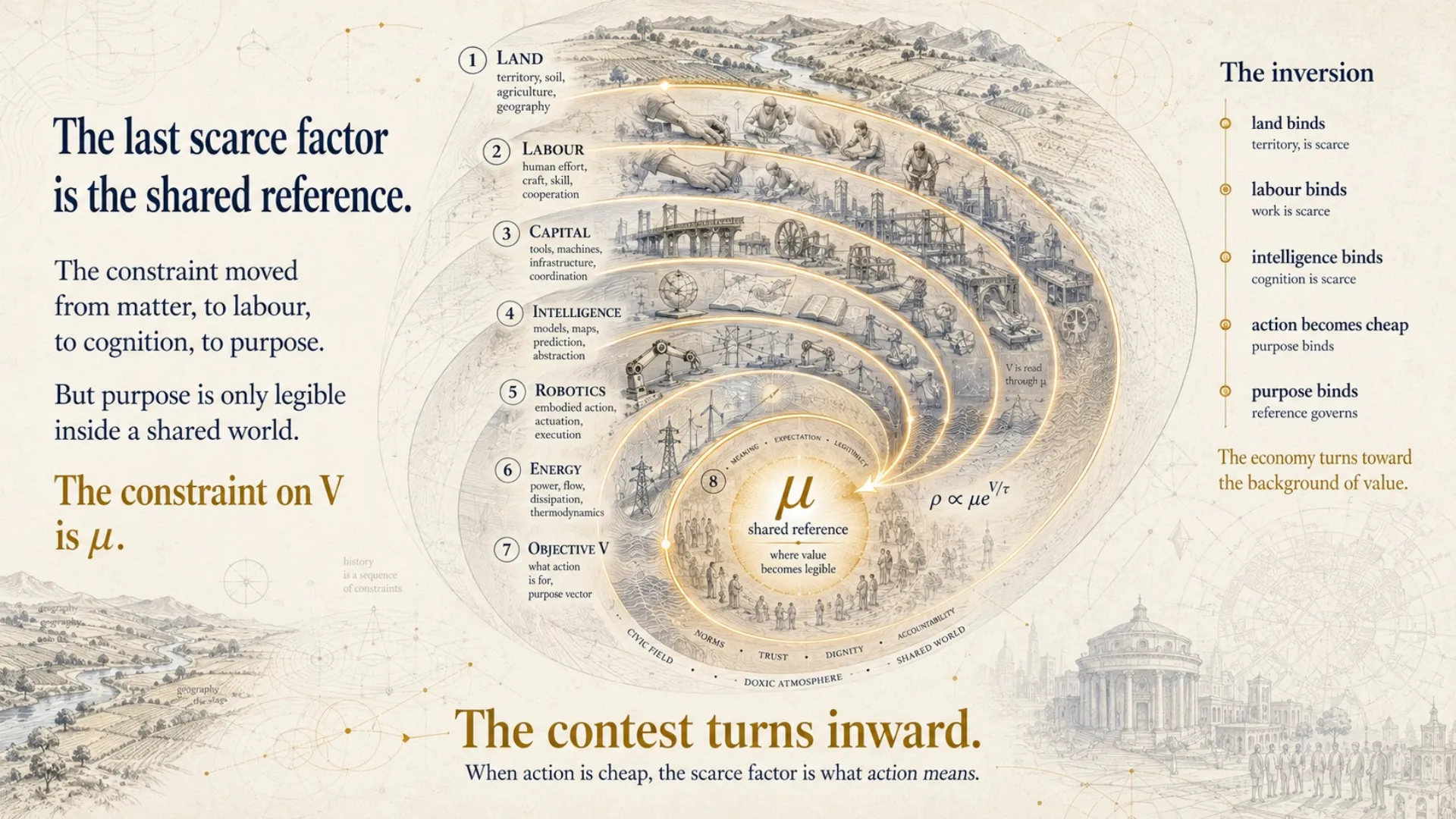
Land, then labour, then capital, then intelligence: the historical sequence of binding constraints is one equation being peeled, outermost term last. It terminates at the reference, and the contest turns inward.
In plain wordsFirst land mattered most, then labour, then money, then smarts. Each scarcity was solved and the next one took over. The paper says the line ends at a strange place: what we expect of each other.
The equation, peeled
The factor sequence is not a list of eras, it is one object read from the inside out. Each stage names the term that binds once everything beneath it is abundant. Step through it; the equation lights up.
ρ∝μ·eV/τ
τeff = τinfo + p·csubK = Kcompute + Kact
Land
empiricalThe oldest binding constraint on the means of action: acreage set the ceiling on provisioning, and rent, not wages, collected the surplus. Agronomy and enclosure peel it; once yield decouples from acreage, land stops binding and the constraint moves inward, to the hands that work it.
Labour
empiricalWith land abundant, human effort binds. Hands and hours are the scarce means of action; the wage prices that scarcity, and the cost of acting, K, is paid in muscle, roughly 100 W of it, biologically pinned.
Capital
empiricalMachinery multiplies labour, so accumulated plant becomes the binding term: whoever holds capital rations action, and finance exists to allocate that scarcity. It stays binding only until the machines that matter start thinking.
Intelligence
identifiedK_compute collapses. Cognition unpins from the 20 W brain and its cost falls with hardware, not biology, the first phase of the inversion, and the reverse of every prior wave: this one automates thought before motion.
Robotics
identifiedK_act collapses, the second phase of the same inversion, not a new event. Actuation cost falls before actuation capability catches up, so the last manual tasks are held by the dexterity premium η_act, not by price.
Energy
empiricalWith cognition and actuation both cheap, the margin left is joules. The floor is Landauer’s k·T·ln 2 per erased bit, the framework’s own KL cost read off at the physical temperature, and provisioning becomes, at the limit, an energy market.
Objective V
forcedCheap cognition can optimise any objective but cannot supply its own. V, what is worth doing, is the one term no amount of compute produces, and it becomes the scarce factor precisely because everything beneath it is abundant.
Reference μ, the terminus
forcedThe outermost term, and the last. μ is the reference expectations are formed against, doxa, an expectational commons that can be enclosed (capture) or depleted (collapse). Past μ there is nothing left to peel: the contest turns inward, to governance of the reference itself.
The sequence itself, that the reference μ is the outermost term, peeled last, with nothing beyond it but its own governance, is derivedforced. The two-phase inversion (K_compute before K_act) is an identification on the structureidentified; the dates and pace of the earlier peels are the historical recordempirical, and illustrative here.
The factor sequence as the equation peeled term by term. Intelligence and robotics are two phases of the kinetic cost collapsing; energy binds at the Landauer margin once action is cheap; the objective V binds when energy is abundant; and the constraint on V is the reference μ, the outermost term, past which lies only its own governance. The terminus is structural.
The inversion already visible
When deciding and acting are nearly free per operation, the binding constraint moves to what every operation consumes: energy, bounded below per irreversible operation by the Landauer margin, together with the capacity to dissipate the entropy both generate. The constraint on frontier computation is already shifting from algorithms to power and cooling, the marginal input large-scale inference bids for is increasingly the joule and the heat budget, not the idea. Embodiment is what makes this inversion bite.
Why the sequence stops
When energy too is abundant, the scarce, non-expropriable factor is the objective V itself, and the constraint on V is the reference μ, against which any objective is legible and coordinable at all. Here the sequence reaches the last term of the structure: μ is what the whole object is defined against, so within the framework there is no further factor external to it for a new inversion to move to. What there is instead is the internal structure of μ, its hierarchy of levels and the question of who sets them.
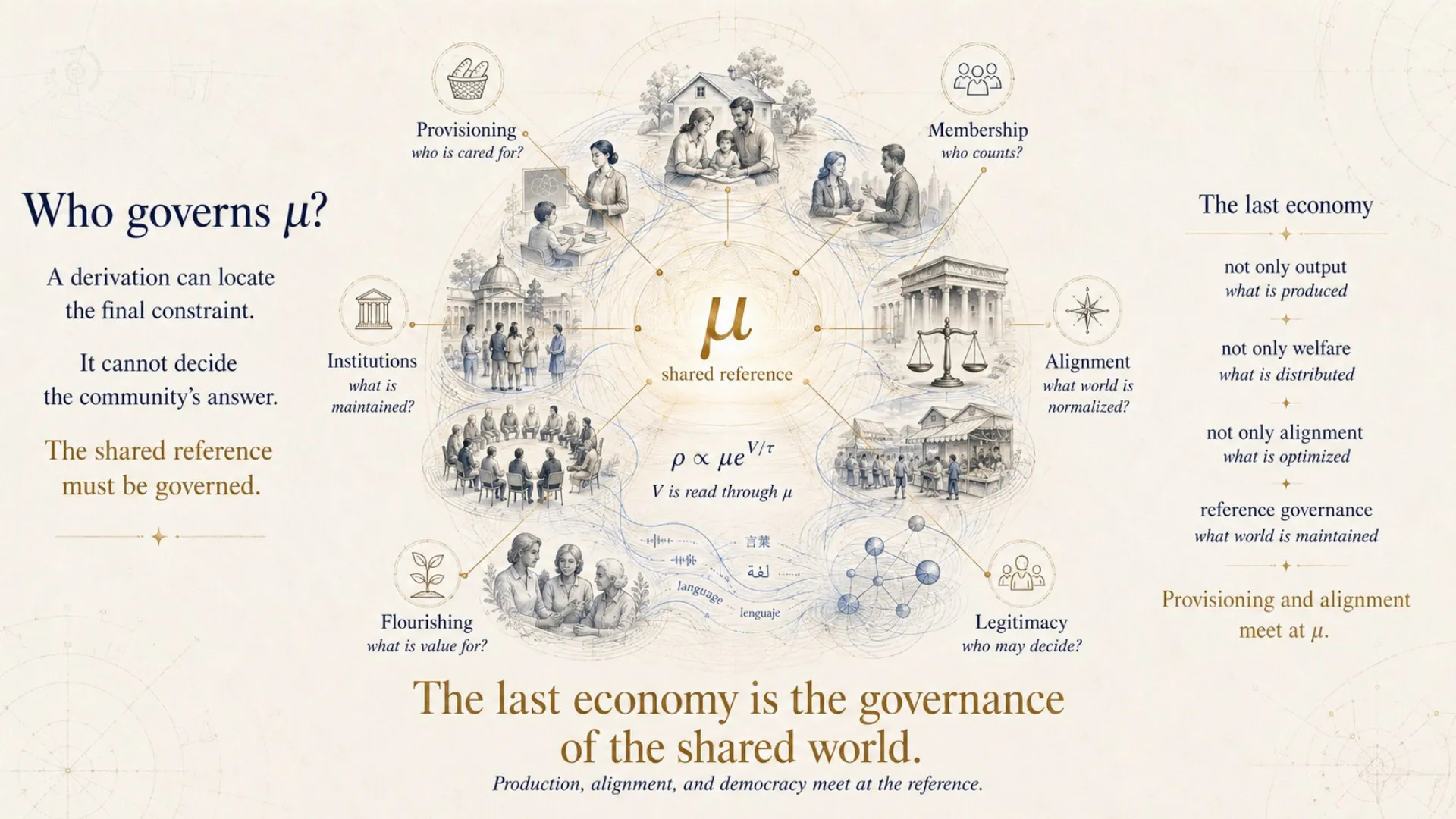
The economy whose binding constraint is the tending of that commons is the last economy: last in the sense that the reference is the outermost term, and the only thing past it is the reference's own governance.
An expectational commons is not owned so much as governed: it can be captured by a few who set it, or left to collapse into incoherence, and either is a way of losing it.
The takeawayWhoever tends the community's doxa when cognition, action, and energy are abundant holds the position land-owners held in the agrarian economy, with the difference that no deed can be written for a shared background of expectation.
From the paper
When energy too is abundant, the scarce, non-expropriable factor is the objective V itself, the specification of what the system is to optimise, which no amount of cheap cognition or action can generate for itself. And the constraint on V is the reference measure μ, the doxa against which any objective is legible and coordinable. … At this terminus doxa is no longer an ambient condition but a contested factor of production, an expectational commons that can be enclosed or depleted, and the economy whose binding constraint is the tending of that commons is the last economy, last in the sense that the reference is the outermost term of the structure and the only thing past it is the reference's own governance.
§7.6 · Result: the inversion sequence terminates at doxa
Why the peeling stops here: past the reference there is only the reference's governance.
From the book
Four times in the last ten thousand years, the foundational source of economic value has inverted. Each time, the world did not just change. It broke and reformed into something unrecognizable.
The Last Economy, ch. 1
The book names; the paper derives. Voice, not a second source of authority.

Part VI
The Last Inversion
Who maintains the shared world now maintains the economy.
Part VI · The Last Inversion15 / 16
Doxic capture, doxic collapse
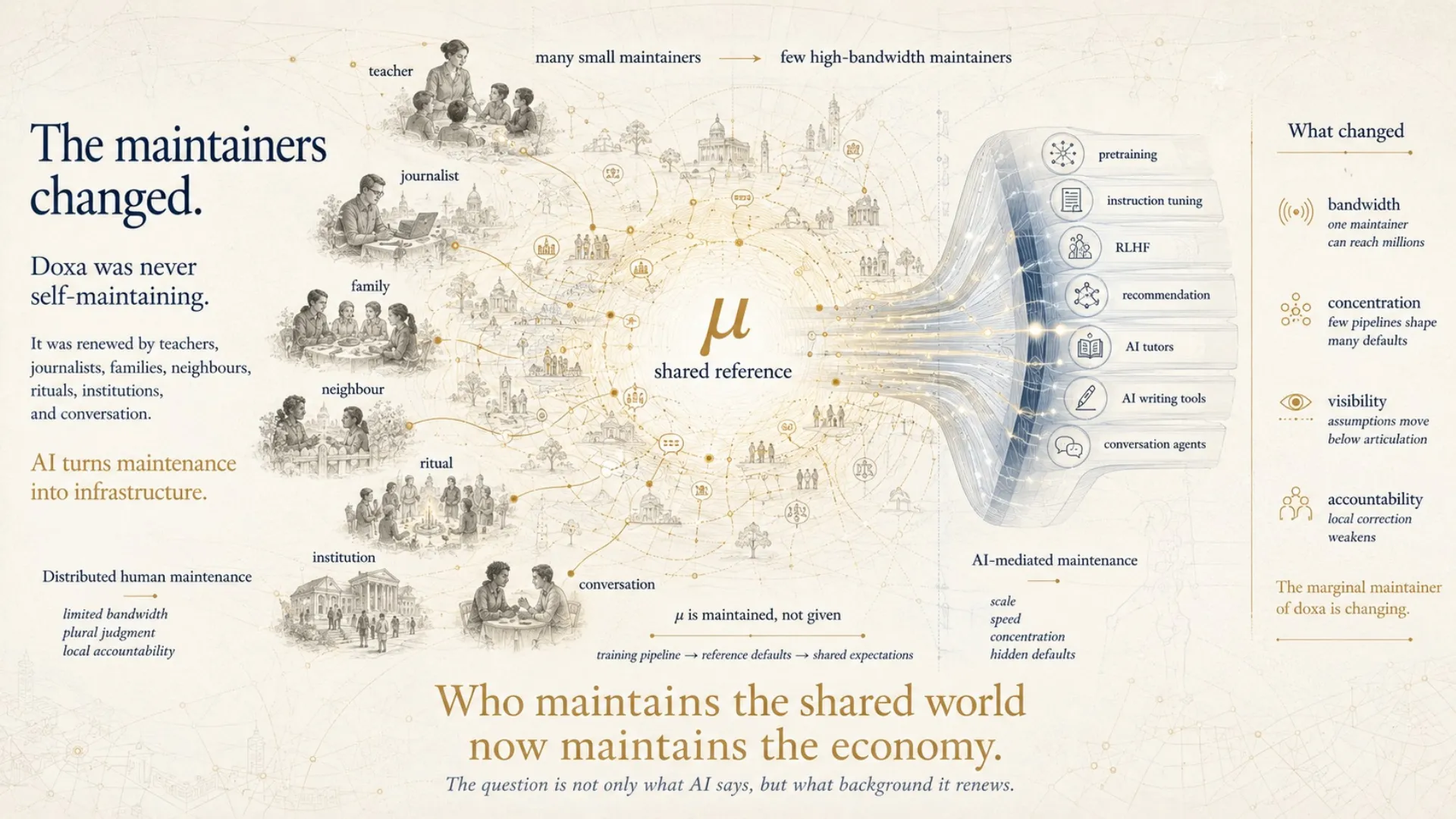
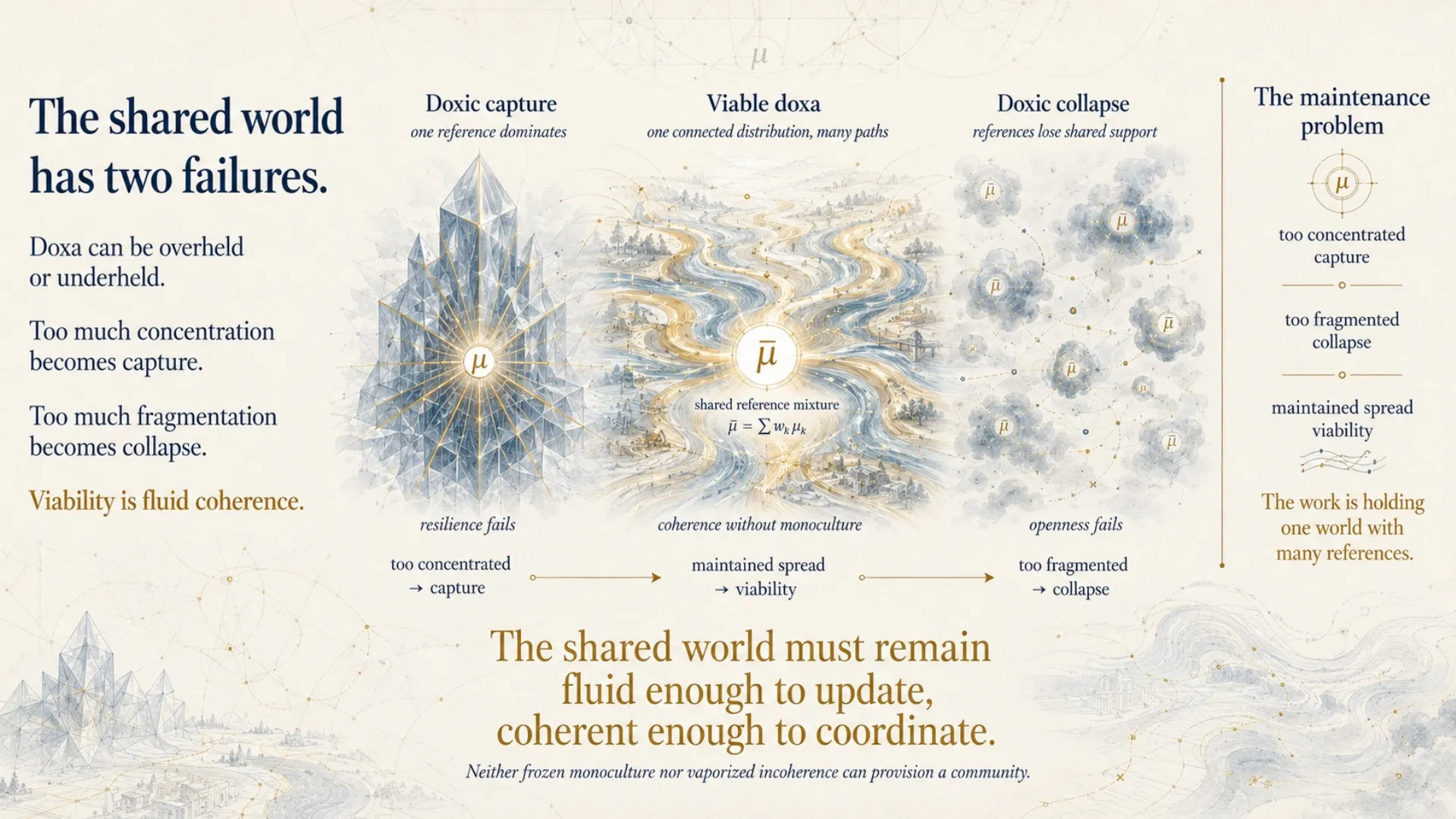
The last inversion can go wrong in two ways, both failures to govern the reference once it becomes the scarce factor: one μ captures the maintenance infrastructure, or incompatible references fragment the shared world into incoherence.
In plain wordsTwo ways to wreck the shared background: let one voice write it for everyone, or let it shatter into a thousand incompatible pieces. AI makes both failures cheap for the first time.
The contest between references
Five references share one population: ẇk = wk(fk − f̄), fitness = predictive accuracy. Raise one pipeline's edge, or still the environment, and watch which failure the interior falls into.
- Top share
- 20%
- Effective references 1/Σw² identified
- 5.0of 5
- Smallest surviving share
- 20%
An interior rest point, no reference owns the population, none dies. It is stabilised only by the fluctuation dial: a shifting environment favours different references at different times (negative frequency dependence). Turn that dial to zero, or raise the gap, and the interior fails one of two ways.
Capture, the resilience failure. One reference has become the population's monoculture: everyone prices, plans and predicts against the same μ, so the state it did not model is the state everyone pays for at once, unboundedly. Diversity was the hedge; it is gone.
Collapse, the openness failure. Shares stay fragmented with no shared support: no common prior survives across the population, so agreement has nothing to converge on and coordination becomes impossible. The commons was not enclosed; it was depleted.
The replicator dynamics, the two failure modes, and the interior's dependence on fluctuating fitness are the paper'sidentified structure; K = 5, the 90% / 30% thresholds and the oscillation driving fitness are illustrative. The paper's warning: automating doxic maintenance, tutors, feeds, assistants trained at a few labs, raises the leading pipeline's gap while weakening the fluctuation coupling. The default under concentrated maintenance is capture.
The contest between references, run as replicator dynamics on maintainer shares, selection proportional to predictive fitness, the framework's own forced family one level up. One dominant fitness ends in capture; fragmentation with no shared support is collapse; the viable interior is held only by negative frequency dependence. The dynamics is the paper's; the parameters are yours.
The provisioning problem
The labour market is, in the framework's language, a concentration of μ at the institutional level: productive activity is performed by people, remunerated through wages, spent on the consumption that sustains them. When production becomes substantially non-human, the mechanism does not fail by misallocation; it fails by referent shift, the concentration linked production to consumption specifically through human labour, and markets cannot rebuild it, because markets are themselves μ-concentrations that coordinate exchange among participants; they do not create new doxic chains.
A universal basic income at the subsistence floor is a partial repair: a thin new concentration in the welfare-distribution domain. But the chain it replaces carried dignity, identity, community, and structure alongside the income, and a transfer payment does not concentrate μ in the same places. People notice, and the noticing is itself a structural fact. What is needed is constitutional work on the institutional layer: new concentrations linking provision to membership directly, without the labour intermediary.
The maintenance shift
Doxa has always been maintained by human missionaries, journalists, teachers, religious figures, neighbours, each with human bandwidth and human idiosyncrasy, none able to set μ alone. As routine missionary work shifts to conversational interfaces, tutors, recommender systems, and AI-assisted writing, the marginal maintainer of a community's doxa becomes an entity whose own μ was set by training choices at a small number of labs.
Two failure modes become available at a scale that was not possible before. Capture: one training pipeline's μ dominates maintenance and the community's background drifts toward it regardless of whether the community would endorse the drift if it could see it. Collapse: incompatible references proliferate across overlapping communities until no two participants in a coordination problem share a prior. Each is the default of its own excess, capture of unrestricted concentration, collapse of unrestricted proliferation.
Alignment is doxic alignment
Behaviour is set by the score ∇V/τ + ∇log μ, so aligning it needs both terms. An AI with aligned values and misaligned doxa passes every value benchmark while pulling, systematically and below the level of articulation, in directions the benchmarks do not measure, the failures live in unstated assumptions, exactly where they are hardest to detect. The framework names μ as a first-class alignment target alongside V.
At the scale of the infrastructure that maintains a population's doxa, this ceases to be a per-model concern: doxic capture is large-scale doxic misalignment toward a dominant μ, doxic collapse is misalignment into incoherence, and the stakes are constitutional rather than local. RLHF already engineers μ; what has not been named is what the reference is, and whose.
The derivation: the contest between references
Once the reference is the scarce factor, references compete to be maintained. This step is modelled, not forced like the links above, but its solution is the chain’s own exponential family.
- 01
Fitness is predictive accuracy
A reference is retained in proportion to how well it lets its adopters predict, so the fitness of reference k is minus its being-wrong cost.
f_k = −H_k
- 02
Shares move by replicator dynamics
Selection proportional to fitness, the standard model of a maintenance contest. The paper’s own word here is modelled, softer than the forced links above.
ẇ_k = w_k·(f_k − f̄), f̄ = Σ_j w_j f_j
- 03
The solution is the forced family
Lineages compounding at their fitness evolve as an exponential tilt, the Link-3 form again, with time in the role of inverse temperature.
w_k(t) ∝ w_k(0)·e^(f_k · t)
capture: w → e_k · collapse: incompatible supports persist
One reference dominating is doxic capture, a resilience failure; incompatible references splitting the population is doxic collapse, an openness failure. The viable case is an interior held open by negative frequency dependence.
No single missionary or institution has been able to set μ alone. The technology of language models changes this.
The takeawayAutomating doxic maintenance strengthens whichever reference is already winning and weakens the only force that keeps references plural. Under concentrated maintenance the dynamics has a default outcome, and the default is capture.
From the paper
Doxic capture is a failure of resilience: the spread of references collapses toward one, and the worst-case complexity cost, finite for a population holding a mixture (the marginal of members holding their own μ_k in shares w_k), runs away for the monoculture when the dominant prior meets the state it did not model. Doxic collapse is a failure of openness: the shared distribution the population's mixture fragments into disconnected components that no longer relax to one attractor… Each is the default of its own excess, doxic capture of unrestricted concentration, doxic collapse of unrestricted proliferation, and holding the population to one connected distribution without crushing its diversity is the central practical challenge of doxic engineering in the AI transition.
§8.2 · The doxic maintenance problem
The two failure modes read as the two halves of the one viability condition.
From the book
Digital Feudalism is the default path of least resistance. The Great Fragmentation is the stable valley of fear. The path to Human Symbiosis is a narrow ridgeline of possibility, requiring deliberate, constant effort to walk.
The Last Economy, ch. 16
The book names; the paper derives. Voice, not a second source of authority.
Part VI · The Last Inversion16 / 16
The governance of μ
Provisioning fails when the concentrations linking production to welfare break; alignment fails when μ drifts or fragments; aggregation fails when voters no longer share a reference. Three problems, one object.
In plain wordsFeeding people who no longer need to work, aligning AI with what we actually mean, and talking across political divides, the paper's parting claim is that these are one problem: who tends the shared background.
One problem seen from three directions
How a community sustains members who no longer produce; how AI systems are aligned with a community's background of expectation rather than only its stated values; how a polarised electorate can aggregate information at all, each is a failure of μ-governance, and because the structure locates all three in one object, a single framework can pose them.
Where the discipline it replaces carried a separate assumption for each result, this one carries one premise and one identification, and both converge on the single object a community must govern. The discipline's existing empirical base is not left behind; it is inherited and re-indexed by the parameters the structure provides.
What stays with the community
Who counts as a member, what flourishing consists in, and on what basis a community provisions members who need not produce are decisions a community makes about itself, not consequences a derivation can deliver. The framework's contribution is to locate the question exactly, and to show that nothing in the structure answers it on humanity's behalf.
In 1492 the abbot Trithemius wrote a treatise defending hand-copying against the printing press; every argument was theological, and none mentioned that his monastery's income came from copying. The monks of St. Gall chose differently, they turned the press's abundance into one of Europe's great libraries, transforming themselves from manufacturers into architects of knowledge. The constitutional question has been answered well before.
The takeawayThe constitutional question stays with the community that owns it, the framework only supplies the substrate on which it can be stated exactly. The future economy is not only built; it is agreed into being.
From the paper
The economy of the claim is the measure of it. The structure rests on a single empirical premise, that persistence selects for prediction, and the classical recoveries follow from what it forces. The subject becomes economics under a single identification, that the social levels of the reference are a community's doxa, and the capitals, the viability conditions, and the terminus follow from that. Where the discipline it replaces carried a separate assumption for each result, this carries one premise and one identification, together with the consistency requirements named at each link and standard regularity, but nothing further, and both converge on the single object a community must govern.
§9 · Closing
The paper's own audit of what it assumed: one premise, one identification.
From the book
The machine has taken our old work. Thank God. Now we can begin our real work.
The Last Economy, epilogue, Brother Gabriel, 1485
The book names; the paper derives. Voice, not a second source of authority.
The discipline that lets them be asked is intelligent economics. The economy that must answer them is the last economy.
Afterword · The Last Economy
Where the book names, this paper derives.
This framework is the formal core of a larger argument made for a general readership in The Last Economy. The book carries the historical, institutional, and human case; the paper supplies the structure beneath it. Every coinage on the left is an object on this page.
- Intelligence Theory
- the one empirical premise, persistence selects prediction
- Sorter’s Law
- minimising the action L = H + C + K
- the Intelligence Lagrangian
- the three forced costs of persistent choice
- the MIND capitals
- the four stocks, read off the three cost terms
- the Three Laws of a Living System
- flow · openness · resilience, the viability conditions
- the Dual Engine
- within-round relaxation, across-round μ ← ρ*
- the Metabolic Rift
- τ_eff = τ_info + p·c_sub, the human floor, the machine’s absence of one
- the Intelligence Inversion
- the cost–capability sweep, Π_H < 0
- the Three Futures
- doxic capture · doxic collapse · the governed interior
One boundary runs the other way: the reference measure and its name,doxa, are the paper's own contribution, the book does not carry them. Part III and Part VI of this page are where the framework goes past the book.